By NeoMarketWays | Insights
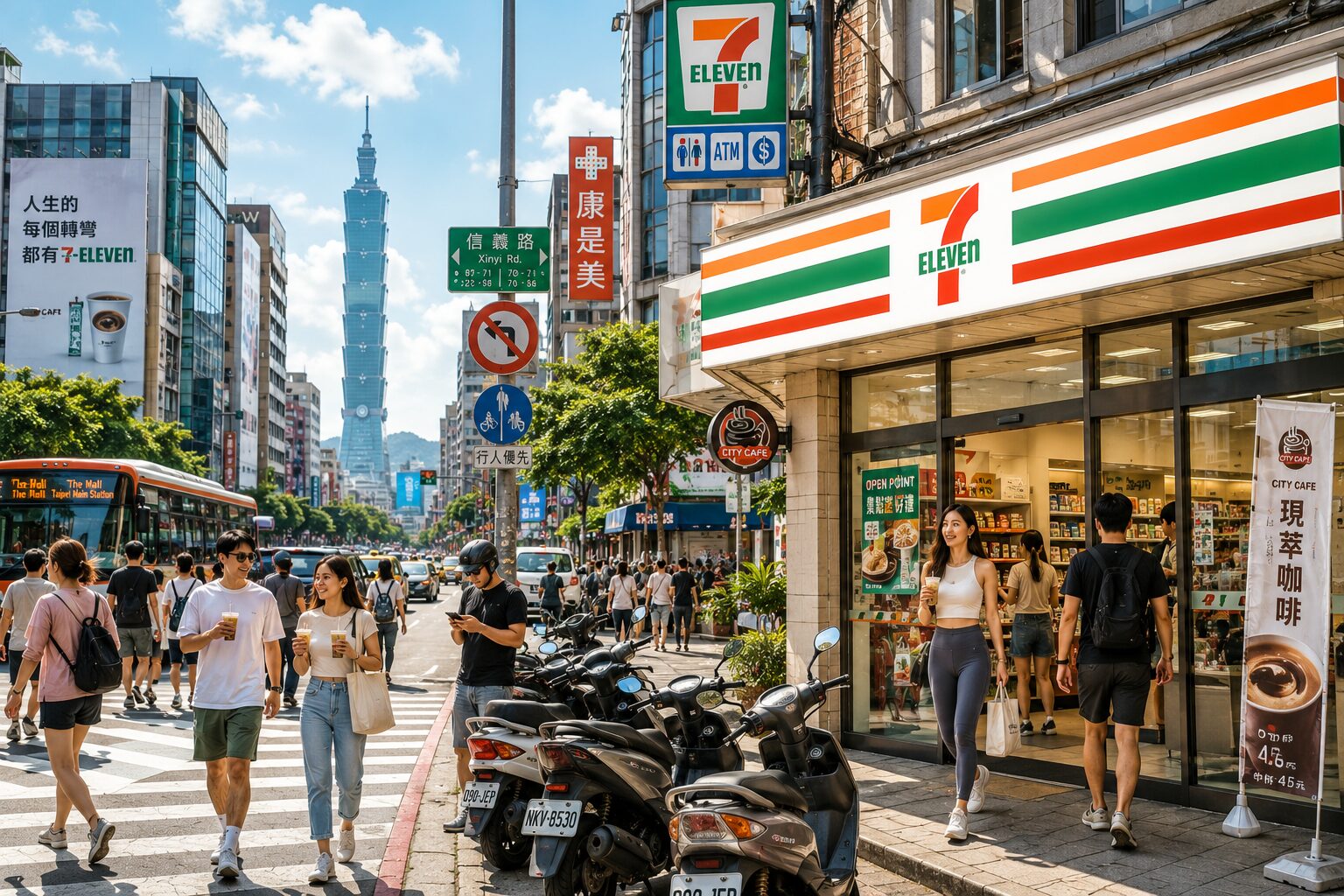
Walk into a 7-Eleven in suburban Taipei at 2 a.m. on a Tuesday, and you will find a salaryman printing tax documents, a college student microwaving a pork rice bowl, a grandmother paying her electricity bill, and a delivery driver picking up a parcel. The store is immaculate, brightly lit, and staffed with a cheerful efficiency that would make a Swiss watchmaker envious. This is not the 7-Eleven of American gas-station lore. This is something else entirely: a social institution woven into the daily rhythm of 23 million people.
Taiwan has quietly built the most sophisticated convenience store ecosystem on the planet. With more than 14,000 outlets for a population of roughly 23 million, the island claims one store for approximately every 1,650 residents, making it one of the densest convenience retail markets in the world, trailing only South Korea. Yet raw density tells only a fraction of the story. What truly sets Taiwan’s convenience stores apart is the extraordinary depth of services they offer and the cultural weight they carry in everyday Taiwanese life.
The Numbers Behind the Phenomenon
The scale is staggering. The convenience store boom in Taiwan began in 1980 with the opening of the country’s first 7-Eleven, and by 2024, nationwide sales surpassed US$13 billion (NT$394.5 billion), with 7-Eleven alone accounting for more than half.
Convenience stores accounted for a 29% share of Taiwan’s total retail market in 2025, a dominance unmatched by any comparable retail format in any comparably sized economy. The segment generates an estimated annual revenue of US$15 billion, and it is still growing.
President Chain Store’s 7-Eleven network operated 6,859 outlets in 2024, averaging TWD 30.1 million (USD 940,000) in sales per store and offering same-day delivery to nearly every urban household. These are not marginal numbers. Each store is, by global convenience retail standards, a high-performing unit in an extraordinarily competitive network.
The Players: A Four-Chain Oligopoly
Taiwan’s convenience retail market is effectively controlled by four chains, each with a distinct character and strategic positioning.
7-Eleven is the undisputed leader. Operated by President Chain Store Corporation, a subsidiary of the Uni-President Enterprises conglomerate, it holds approximately 47.9% market share and is present in every single district across the island. As of mid-2024, 7-Eleven operated 7,021 locations, including outlets on Taiwan’s outlying islands. The chain maintains over 100 stores in 11 districts alone, primarily in the densely populated cores of major cities.
FamilyMart is the strong second player, operated in Taiwan by Uni-President Enterprises, the same parent company as 7-Eleven, giving the conglomerate a commanding grip on the sector. FamilyMart operates 4,251 stores, leading 7-Eleven in 19 districts and maintaining equal presence in 34 others. The chain differentiates through its premium prepared food proposition and aggressive digital integration, including AI-powered inventory management.

Hi-Life and OK Mart round out the competitive set. Taiwanese Hi-Life has approximately 1,590 locations, while Canadian-branded OK Mart operates around 900 outlets, both focusing on regional penetration and value positioning. More recently, Shopee has experimented with physical stores to provide consumers with an alternative package pickup option, aiming to enhance average transaction values.
More Than a Store: The Cultural Infrastructure
To understand why Taiwan’s convenience stores are so deeply entrenched, one must understand something about Taiwanese society. Sociologist Chang Li-hsiang, who has written a book on Taiwan’s convenience stores, notes that as the Taiwanese economy grew, so did the store count. Taiwan, often dubbed the “island of overwork,” ranks among the world’s highest in working hours while leisure time remains scarce. Children do homework after school while waiting for their parents. Young professionals living alone rely on convenience stores for meals and daily errands. Retirees gather to drink coffee and chat. Even during typhoons, when other shops close, convenience stores remain open.
The service offering has evolved far beyond snacks and beverages. In 2006, the iBon kiosk system was introduced at 7-Eleven, allowing customers to book travel, pay utility bills and fines, buy movie tickets, print and scan documents, access land records, check pension information, verify identity, hail taxis, and even search for employment. Tasks once scattered across banks, post offices, and government agencies are now concentrated in a single corner store. This is the convenience store as civic infrastructure.
According to a 2020 survey, around 84% of respondents named convenience stores as their favorite offline shopping channel, the highest among all retail channels. That figure speaks volumes about the depth of consumer trust and habitual reliance these chains have cultivated over four decades.
The food culture embedded in these stores is equally remarkable. The tea egg, a staple simmering in 7-Eleven’s iconic hot pot, is perhaps the most culturally loaded product in Taiwanese retail. When 7-Eleven began selling locally sourced fresh foods in the 1990s, its US parent company worried that tea eggs might be too pungent. They quickly became a bestseller. The lesson was clear: localization, not standardization, was the key to winning Taiwan.
Technology: The Next Frontier
Taiwan’s convenience chains are not resting on their laurels. Faced with a saturating market, they are investing heavily in technology to extract more value from each square meter.
FamilyMart has implemented AI-powered inventory systems, while 7-Eleven is deploying unmanned store technologies to reduce labor dependency. Blockchain-based payment pilots and computer-vision shelf monitoring are already in field trials. The strategic logic is clear: with store counts approaching a natural ceiling, same-store sales optimization through technology becomes the primary growth lever.
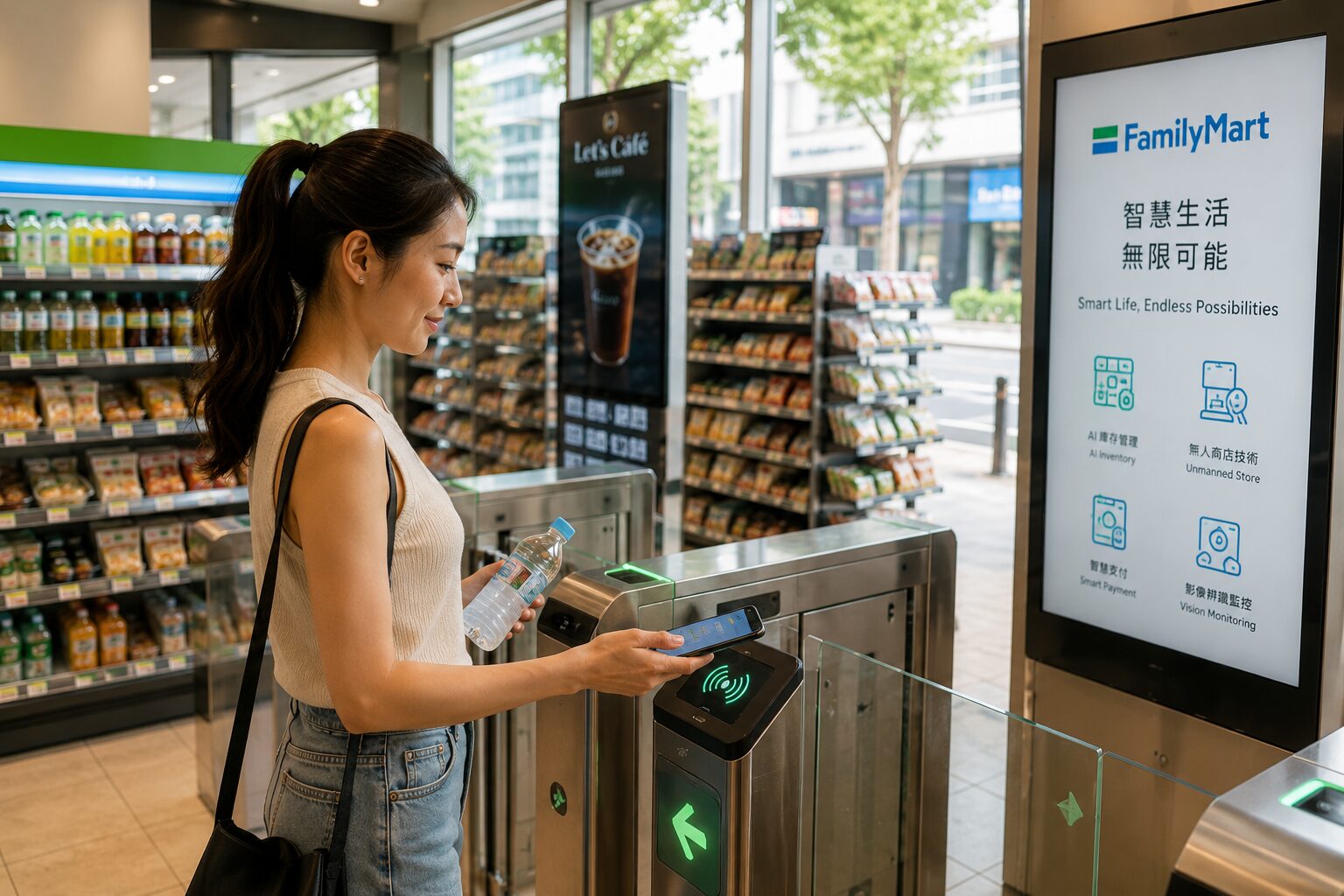
Major chains are also launching hybrid store formats, including convenience cafes and convenience-drugstores, blurring the line between traditional retail categories. This format evolution reflects a broader truth about Taiwan’s CVS (convenience store) sector: it has become the testing ground for the future of physical retail in Asia.
Market Entry: Opportunity and Complexity
For international brands and product manufacturers, Taiwan’s convenience store network represents one of the most efficient distribution channels in Asia, and one of the most demanding. Getting a product into 7-Eleven or FamilyMart means instant access to tens of millions of consumer touchpoints, but the barriers are real.
The key considerations for market entry are threefold.
First, localization is non-negotiable. Taiwan’s consumers are sophisticated and flavor-specific. Products must be adapted to local taste profiles, portion sizes, and packaging norms. The early failure rate for imported products that enter without localization is high.
Second, logistics and cold-chain capability are critical. Taiwan’s CVS operators run some of the tightest supply chains in the world, with multiple daily deliveries and razor-thin inventory buffers. Suppliers must be capable of meeting these operational standards without exception.
Third, the promotional machinery matters. Major retailers run sophisticated in-store promotional programs, including limited-edition collectibles, seasonal tie-ins, and loyalty stamp campaigns, that drive repeat traffic. Foreign brands that align with these promotional cycles gain outsized visibility.
Japan’s LOPIA supermarket entered Taiwan in 2023 and expanded aggressively into locations like Taichung and Kinmen, appealing to both local and tourist consumers. It is a reminder that well-positioned foreign formats can find a foothold, but only with precise market reading.
Taiwan Market Entry Journey
Saturation and What Comes Next
The market faces a structural tension. Taiwan’s retail density is approaching physical limits, with more than 13,706 convenience store outlets creating one store per 1,703 people. This saturation triggers cannibalization effects where new store openings primarily redistribute existing demand rather than generating incremental sales growth.
The industry’s response has been strategic consolidation at the top. In 2023, Uni-President acquired Carrefour from the French group, creating a vertically integrated conglomerate now operating more than 6,800 7-Eleven convenience stores, 67 Carrefour hypermarket stores, 246 Carrefour supermarket stores, and 22 high-end Mia C’bon stores. This is arguably the defining structural shift in Taiwanese retail of the past decade.
The future of Taiwan’s convenience stores will be written in data, digital services, and format innovation, not in store count. The chains that master the art of serving Taiwan’s aging population, its time-poor urban professionals, and its digitally native youth, all from the same 30-square-meter footprint, will define the next chapter of one of retail’s most extraordinary success stories.

Taiwan’s convenience stores are not simply places to buy things. They are, by any serious measure, among the most socially embedded retail institutions in the world. For the global retail industry, they are a masterclass in what convenience can become when taken seriously.

Further Market Insights
- Taiwan Beer and the Rise of Modern Taiwanese Beer Culture.
- Taiwan Grocery Retail Market. One of Asia’s Most Advanced Food Retail Ecosystems
- More Than Convenience. What 7-Eleven’s Little Red House Says About Hong Kong
- Taiwan Business Opportunities. Key Economic Sectors Beyond Semiconductors
- Taiwan Convenience Store Market. Why 7-Eleven and FamilyMart Dominate Retail Distribution