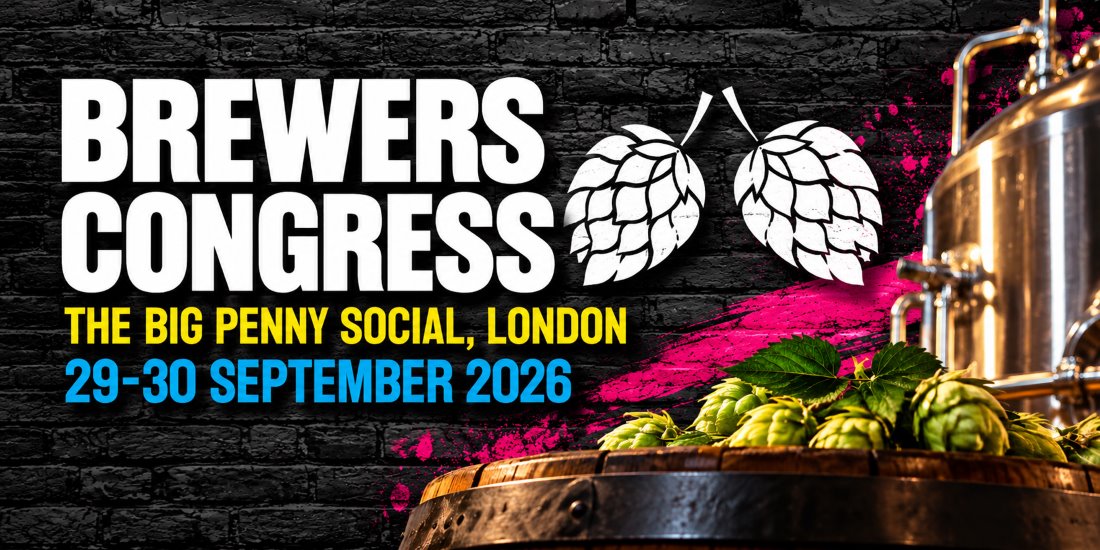
London has once again become a meeting point for brewers, beer entrepreneurs, suppliers and industry experts. The Brewers Congress 2026, held on 29 and 30 September at Big Penny Social in Walthamstow, brings together the brewing industry at a time when producing an excellent beer is only one part of building a successful brewery.
The bigger commercial question increasingly begins after the beer leaves the brewery. How does a brewery find new customers, enter new markets and secure access to the retailers, wholesalers and distributors capable of turning a good product into an international brand?
Brewing creates the product. Distribution determines where the consumer can discover it.
The Brewers Congress is increasingly about business as well as brewing
The Brewers Congress remains firmly rooted in brewing, production and innovation. Yet its 2026 programme also reflects the commercial questions facing today’s breweries.
Sessions address brand equity and consumer trends, commercial strategy, sales scaling and supermarket distribution. One panel focuses specifically on breaking into Britain’s major supermarkets, while another looks at exporting UK craft beer after Brexit and unlocking international markets.
This matters because the challenges facing independent breweries are changing. Quality remains fundamental, but breweries must also think about positioning, route-to-market strategy, distribution, packaging, price and the environments in which consumers encounter their brands.
Why convenience stores matter for beer brands
Convenience retail occupies an interesting position between supermarkets, hospitality and specialist drinks retail. Consumers often enter convenience stores with a different mission from a weekly supermarket shop. Purchases can be immediate, local and occasion-driven: a drink after work, beer for an evening with friends, something new to try or a chilled product needed immediately.
This makes convenience stores potentially attractive for established international beer brands as well as smaller breweries seeking new routes to consumers.
The UK, Germany, Czech Republic, Poland and other European markets have very different retail structures. Convenience may mean an independent corner shop in Britain, a petrol station in Germany, a neighbourhood store in Prague or a highly organised modern convenience network in Poland.
Getting from brewery to convenience store
One of the most common misconceptions about international expansion is that a brewery simply needs to find an importer. Importers can be important, but the real route to market can involve several players: importers, beverage distributors, wholesalers, buying groups, retail chains and independent stores.
A brewery considering how to sell beer to convenience stores in Europe should therefore start with the structure of the target market.
Who supplies the stores? Which wholesalers dominate the channel? Are buying decisions centralised? How important are independent retailers? What margins are expected? Does the retailer require promotional support? Which package formats perform well? And, crucially, why should a retailer replace an existing product with a new beer?
International market entry is not about finding somewhere that could sell your beer. It is about understanding who controls access to the consumer.
The UK: wholesalers and fragmented convenience retail
For breweries considering the UK convenience store market, the structure can initially appear complicated. Large supermarket groups operate smaller convenience formats, but the market also includes symbol groups, forecourt retailers, wholesalers and a large independent retail sector.
This means that gaining access to UK convenience stores may involve a very different strategy from gaining a supermarket listing.
For some international breweries, identifying the right UK beer importer or drinks distributor may be the logical first step. For others, specialist retail, regional wholesalers or selected independent convenience stores could provide a way of testing consumer demand before attempting broader distribution.
Europe requires more than one beer market entry strategy
The situation changes again when a brewery crosses the English Channel. Germany has strong supermarket and beverage retail structures alongside petrol stations, kiosks and travel retail. The Czech Republic combines organised grocery retail, petrol stations and a significant independent neighbourhood store sector. Poland has developed one of Europe’s most sophisticated modern convenience environments.
A beer that succeeds in British independent stores may therefore require a completely different European beer distribution strategy for Prague, Warsaw or Berlin.
Low and no alcohol opens another convenience opportunity
One of the notable subjects at the Brewers Congress 2026 is the continuing development of low- and no-alcohol beer.
For convenience retail, this category is particularly interesting because it can create consumption occasions beyond traditional alcohol purchasing. A well-positioned alcohol-free beer can compete not only with beer but also with premium soft drinks and other adult beverages.
For breweries entering international markets, low- and no-alcohol products may therefore require their own route-to-market analysis rather than simply following the distribution strategy of the alcoholic portfolio.
From craft brewery to international consumer brand
Perhaps the most important lesson from today’s brewing industry is that being a successful brewer and building a scalable consumer brand are related but different challenges.
International expansion requires a clear understanding of where a brand belongs. Is it a specialist craft beer? A premium imported beer? A product for restaurants and bars? A supermarket brand? A convenience store product? Or could different channels play different roles as the brand develops?
The question is no longer simply whether consumers will like the beer. The question is whether the brand fits the market, the channel and the moment of consumption.
Market entry starts before the first retailer meeting
For breweries exploring the UK or continental Europe, approaching retailers should rarely be the first step. A structured beer market entry assessment can identify the size and structure of the market, competing brands, potential importers and distributors, relevant convenience chains, wholesalers, expected retail prices and suitable routes to market.
At NeoMarketWays, we look at market entry from exactly this perspective: connecting international manufacturers and consumer brands with local market intelligence, distribution channels, potential partners and retail opportunities across Europe and Asia.
Events such as the Brewers Congress demonstrate the creativity and technical expertise that exists inside today’s brewing industry. The next opportunity for many of those breweries may lie beyond the brewhouse. In a new city, a new country and perhaps in the refrigerator of a convenience store thousands of kilometres from home.
More Insights on Drinks and Brewing
New company aims to address CO2 demand Source: The Brewers Journal
Cask should mean choice, Birmingham-based brewery says Source: The Brewers Journal
Related Articles and Insights
- Convenience Store Listing Costs: Fees, Margins and Trade Promotions
- Get Your Product Into Convenience Stores: A Step-by-Step Guide
- How to Find the Right Convenience Store Distributor for Your Brand
- How to Sell Products to Convenience Stores in the Czech Republic
- Market Entry Framework for Food and Beverage Brands: A Strategic Guide to International Expansion