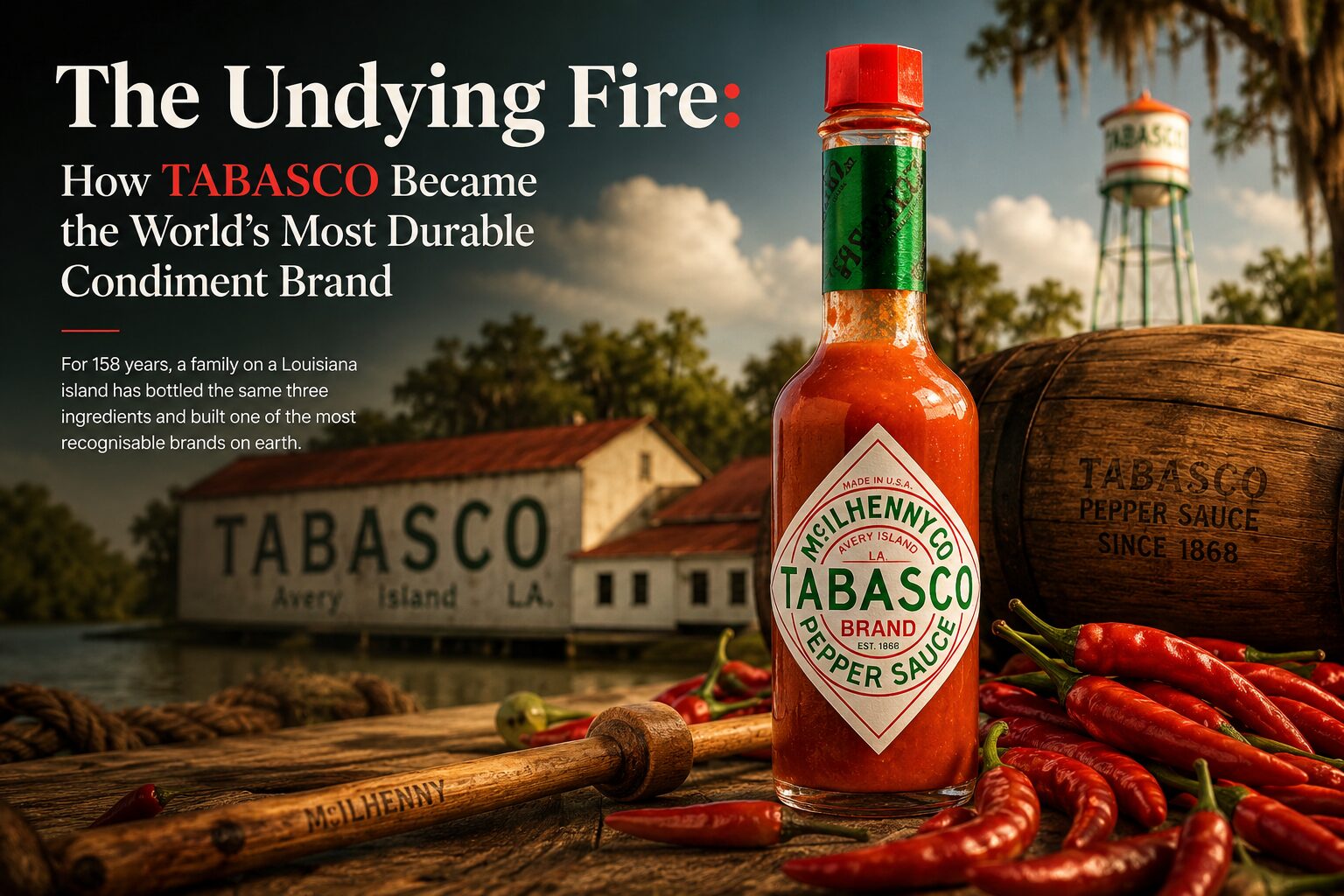
For 158 years, a family on a Louisiana island has bottled the same three ingredients and built one of the most recognisable brands on earth. As rivals multiply and palates globalise, the question is no longer whether TABASCO can survive. It is whether it can lead.
There is a particular kind of corporate confidence that comes only with time. TABASCO sauce, three ingredients, one island, one family has been bottled in more or less the same manner since Edmund McIlhenny first stoppered his repurposed cologne flasks with hand-poured green wax in 1868. That the formula has barely changed is not stubbornness. It is strategy.
Today, the McIlhenny Company produces approximately 750,000 bottles daily from its ancestral home on Avery Island, a salt dome rising from Louisiana’s Cajun bayou. Those bottles reach more than 195 countries, are labelled in 22 languages, and generate an estimated $200 million in annual revenue from a company valued, by most informed accounts, at somewhere between $2 and $3 billion. For a privately held, family-run enterprise now entering its sixth generation of ownership, those are numbers that most venture-backed consumer brands would find quietly humbling.
There was no commercially sold hot sauce before TABASCO. Edmund invented the category.
That claim, made by Tony Simmons, great-great-grandson of the founder and until recently CEO is not mere bravado. It is a statement of category genesis that underpins the brand’s entire identity. TABASCO did not enter an existing market. It created one. And for over a century, it cultivated that market with a patience that modern brand managers, beholden to quarterly reporting cycles, could scarcely imagine.
The anatomy of permanence
What gives TABASCO its peculiar resilience is a combination of factors that are, individually, replicable but together, nearly impossible to assemble from scratch. The sauce itself ages in white oak barrels for up to three years, a process that imbues it with a complexity belied by its three-ingredient simplicity. The pepper mash is still evaluated using a hand-crafted wooden “bung stick,” whittled to measure precisely the depth of fermentation. These are not affectations. They are the material embodiment of what branding consultants spend years trying to synthesise: authentic differentiation.
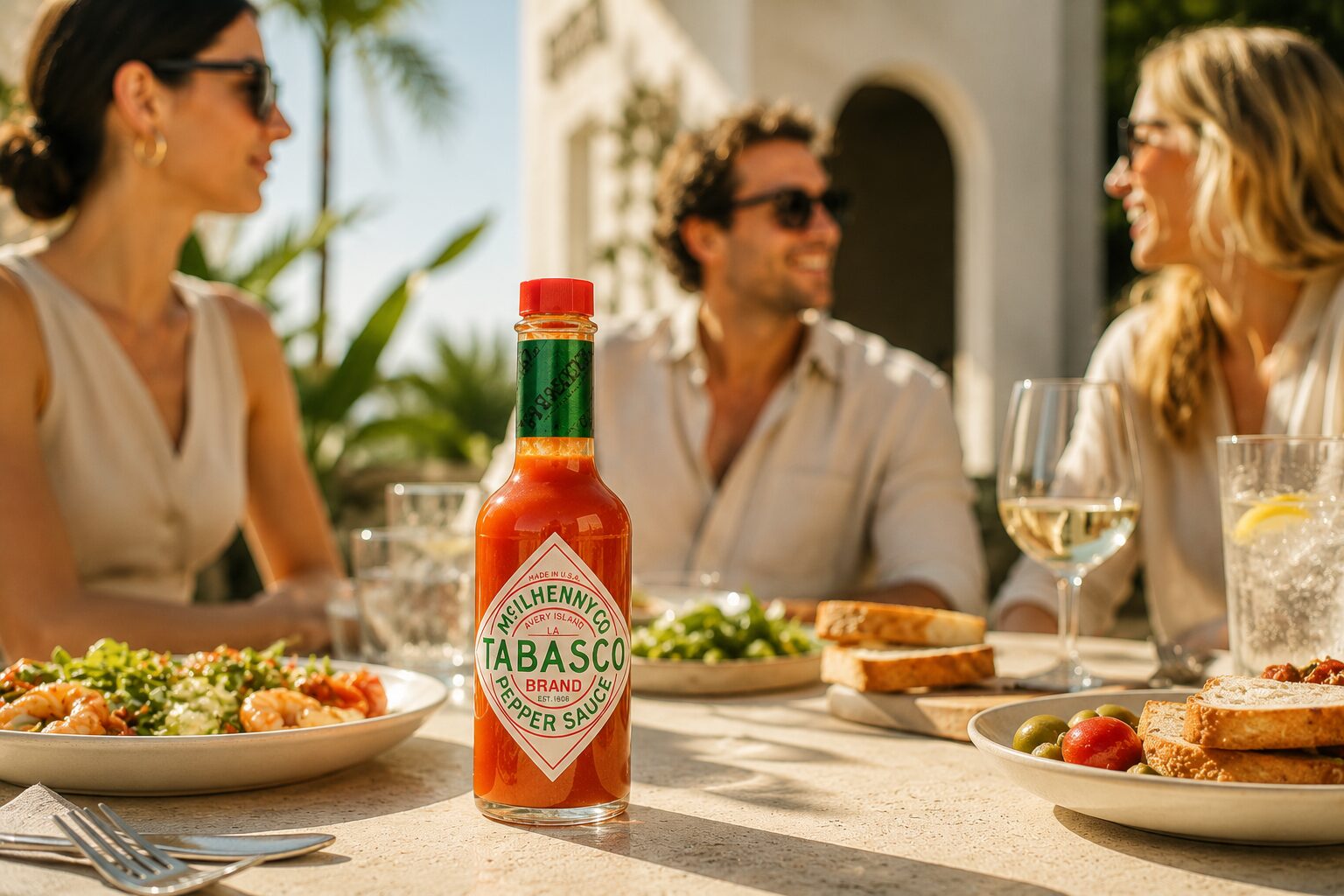
The brand’s institutional endorsements reinforce that premium positioning. TABASCO holds the distinction of being the only non-British food manufacturer to have received a Royal Warrant making it, in effect, the official hot sauce of the British Crown. It is served on Air Force One. It has accompanied astronauts aboard the International Space Station. It appears in US Army ration packs. Each of these placements is, in brand terms, an act of curation an implicit statement that TABASCO belongs in rarefied company.
The competition heats up
TABASCO’s dominance, however, is not unchallenged. The global hot sauce market, valued at approximately $5.27 billion in 2025 and projected to grow at a compound annual rate of 5 per cent through 2035, has become a destination for insurgent brands, artisan producers, and celebrity-backed startups. Frank’s RedHot commands 11.3 per cent of the US market. Huy Fong’s Sriracha holds 8 per cent and has entered the cultural lexicon in a way that few condiments achieve in a generation. Cholula, Valentina, and a constellation of small-batch producers have carved meaningful niches within the very market TABASCO pioneered.
In response, McIlhenny has pursued a strategy of controlled expansion: extending the core line to eight sauce variants from the habanero-forward to the chipotle-smoked, while preserving the integrity of the original. In August 2024, the company launched TABASCO Salsa Picante, its first Mexican-style hot sauce, made with red jalapeños and positioned squarely for Tex-Mex applications. It is a measured incursion into adjacent territory, executed without disrupting the mothership.
From condiment to lifestyle property
Perhaps the most telling indicator of TABASCO’s evolving brand ambitions arrived in 2025, when McIlhenny appointed IMG the global sports and entertainment licensing giant, as its partner to develop a portfolio of licensed consumer products and experiences. The move signals a deliberate shift: TABASCO is no longer content to be merely a bottle on a table. It intends to be a lifestyle property, woven into apparel, accessories, and cultural moments in the way that legacy brands like Levi’s or Jack Daniel’s have managed before it.
That repositioning carries real risk. The brand’s authority rests on specificity and authenticity on the idea that Avery Island, Louisiana is not merely a location but a provenance. Licensing agreements, if poorly curated, have a way of diluting exactly the mystique that makes a heritage brand worth licensing in the first place. The challenge for McIlhenny’s leadership is to extend TABASCO’s cultural footprint without dispersing its essence.
TABASCO is no longer content to be merely a bottle on a table. It intends to be a lifestyle property.
The family calculus
Underlying all of this is the quieter drama of family stewardship. Statistically, the McIlhenny Company is an outlier of almost absurd improbability. Fewer than 30 per cent of family businesses survive into the second generation; only 12 per cent make it to the third. The McIlhennys are now on their sixth. Forbes has placed the family among America’s wealthiest food dynasties. Yet the company remains privately held, fiercely protective of its financial data, and by all appearances committed to remaining so.
That privacy is both an asset and a limitation. It permits long-term decision-making unconstrained by shareholder expectation, a luxury that has allowed the three-year ageing process to endure even as cost pressures mount. But it also limits access to capital at the scale that a truly global brand expansion might eventually require. As the licensing strategy with IMG suggests, McIlhenny is exploring new architectures of growth ones that monetise the brand without surrendering control of it.
The long view
What TABASCO offers the analyst, finally, is something rarer than a good product or a well-run company: a case study in the compounding returns of patience. The brand has outlasted empires, recessions, two world wars, and the arrival of Sriracha. It has done so not by chasing trends but by remaining, stubbornly and deliberately, itself while selectively adapting at the margins. In a consumer landscape increasingly defined by velocity and disruption, that is, paradoxically, its most disruptive quality.
The bottle is still small. The label is still diamond-shaped. The pepper mash still ferments in white oak barrels on a Louisiana island that most people could not find on a map. And yet, on any given morning, in kitchens from Löbau to Lagos, from London to Lima, someone reaches for it without thinking. That, in the end, is what a truly global brand looks like.

Further Insights
- From Local Kebab Shop to Investment Story: How Dristor Kebap Is Building Romania’s Next Consumer Brand
- Inside Avery Island: The Business Behind the World’s Most Famous Hot Sauce
- The Business of Sriracha. Branding, Growth and Global Success.
- Unlocking Europe. A Practical Guide to Market Entry for OEM Companies.
- European Market Entry: Strategies, Partners and Business Expansion Guide
- Best Agencies for Market Entry in Europe
- How Startups Successfully Enter International Markets