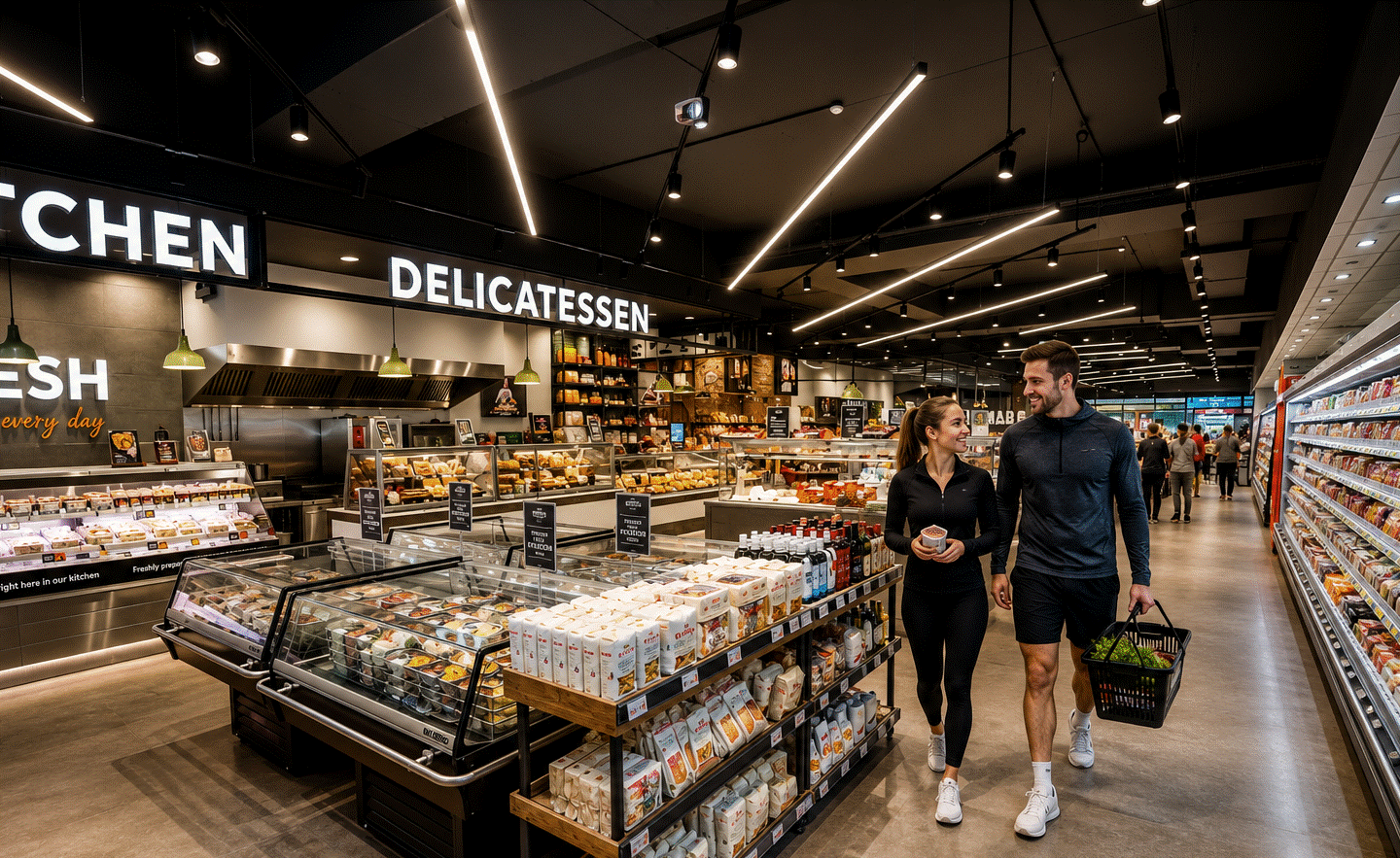
Walk through almost any premium supermarket in Warsaw, Bucharest, London, Singapore or Taipei and one observation quickly becomes apparent: consumers are buying from brands that originated thousands of kilometres away. Italian pasta sits beside Korean instant noodles. Scandinavian oat milk competes with local dairy products. Japanese sauces share shelf space with Mexican salsas, while craft beverages from small European producers appear alongside multinational giants.
For food and beverage companies, international expansion has never been more accessible and never more competitive.
Global logistics networks have reduced transportation costs, digital marketing allows brands to build awareness before entering a market, and retailers are continuously searching for innovative products that differentiate their assortments. At the same time, consumers have become increasingly curious, travelling more frequently and developing an appetite for international flavours, healthier alternatives and authentic food experiences.
Yet despite these favourable conditions, international expansion remains one of the most misunderstood growth strategies in the consumer goods industry.
Many companies continue to believe that exporting products automatically creates an international business. Others assume that signing a distributor agreement is sufficient for sustainable growth. Reality tells a different story.
The world’s most successful brands from Ferrero and Barilla to Red Bull, Chobani, Oatly and Yakult did not simply export products. They built carefully designed market entry systems that combined research, regulatory preparation, local partnerships, cultural adaptation and long-term brand building.
This distinction is becoming increasingly important as retailers demand more sophisticated category management, consumers expect products to reflect local preferences and governments tighten food safety regulations. Successful international food brand expansion therefore requires much more than operational excellence it requires strategic market architecture.
This article presents a practical market entry framework food companies can apply when entering international markets. Whether launching premium beverages, dairy products, confectionery, snacks or packaged foods, the same strategic principles repeatedly determine success.
Key Insight: International growth is not an export project. It is the systematic creation of local competitive advantage.
The New Geography of Food Brand International Expansion
Over the past two decades, global food markets have undergone profound structural change. Rising incomes, urbanisation and digital commerce have transformed consumer behaviour across Europe, Asia and the Middle East. Premium imported products, once confined to luxury retailers, are now available in mainstream supermarkets and online grocery platforms.
For ambitious companies, this shift has created unprecedented opportunities for food brand international expansion. Markets that were previously difficult to access can now be approached through specialised distributors, modern retail networks and cross-border e-commerce platforms.
Several long-term trends are accelerating this development:
- Consumers increasingly seek authentic international brands.
- Health-conscious buyers actively search for functional foods and premium beverages.
- Retailers continuously refresh product portfolios to differentiate from competitors.
- Digital commerce enables market testing before large-scale investments.
- Tourism exposes consumers to international food experiences that later influence purchasing decisions at home.
However, expansion opportunities differ considerably between product categories. Premium coffee brands follow different pathways than frozen food manufacturers. Craft beverage producers face different regulatory environments than confectionery companies. Nevertheless, successful businesses consistently follow a structured food market entry strategy rather than relying on opportunistic export activities.
Beyond Exporting: Why Strategy Matters More Than Geography
One of the most common misconceptions among growing food businesses is equating export activity with internationalisation.
Shipping products abroad may generate short-term revenue, but sustainable international growth requires far deeper market integration. Companies need to understand how consumers shop, how retailers evaluate suppliers, how regulations differ and how competitive positioning changes across markets.
A robust go to market strategy food brands employ therefore includes several interconnected dimensions:
- Consumer research
- Competitive benchmarking
- Regulatory compliance
- Distribution planning
- Pricing strategy
- Brand localisation
- Retail relationship development
Rather than asking “Can we export?”, successful executives ask a different question:
“How can we become locally relevant while maintaining global brand consistency?”
This strategic mindset separates international category leaders from companies whose products disappear after their first retail listing.
The NeoMarketWays Market Entry Framework
While every market presents unique characteristics, successful expansion projects generally follow a consistent sequence of strategic decisions. Instead of viewing expansion as a single transaction, leading consumer brands treat it as a phased capability-building process.
The following market expansion framework reflects best practices observed across successful FMCG companies entering international markets.
| Phase | Primary Objective | Main Outcome |
|---|---|---|
| 1. Market Intelligence | Evaluate market attractiveness | Country prioritisation |
| 2. Product-Market Fit | Adapt products to local demand | Competitive positioning |
| 3. Regulatory Compliance | Meet legal requirements | Market readiness |
| 4. Distribution Strategy | Select optimal sales channels | Commercial access |
| 5. Partner Selection | Build local ecosystem | Scalable market presence |
| 6. Market Launch | Create demand | Brand awareness |
| 7. Scale-Up | Expand sustainably | Long-term growth |
In the following sections, we examine the first two phases in detail.
Step 1: Market Intelligence- Choosing the Right Market Before Entering It
The most expensive market entry mistake is selecting the wrong market not executing poorly in the right one.
Many expansion decisions are driven by anecdotal evidence, trade fair conversations or distributor enquiries. While these signals may indicate opportunity, they rarely provide sufficient strategic insight.
Professional FMCG market entry begins with structured market intelligence.
A comprehensive assessment typically examines:
- Market size and growth rates
- Consumer purchasing power
- Competitive intensity
- Retail concentration
- Import dependence
- Local production capacity
- Price positioning
- Distribution structures
- Regulatory complexity
- Cultural preferences
Equally important is understanding where value is created throughout the distribution chain. In many countries, supermarket groups dominate purchasing decisions. In others, specialised wholesalers, food importers or regional distributors remain the primary gatekeepers.
Successful consumer goods market entry therefore requires analysing not only consumers but also the commercial ecosystem connecting producers with retailers.
Strategic Question: Are you entering a consumer market or a distributor market?
The answer fundamentally influences investment priorities, pricing strategies and partnership models.
Step 2: Product-Market Fit. Winning Consumers Before Winning Shelf Space
Retail listings rarely fail because products lack quality. More often, they fail because products lack relevance.
Consumers evaluate imported products through local expectations. Taste preferences, portion sizes, nutritional priorities, packaging formats and purchasing occasions differ substantially across countries.
Consequently, effective food market entry requires much more than translation. It demands thoughtful adaptation without compromising brand identity.
Successful international brands typically review five dimensions before entering a market:
- Product formulation
- Packaging design
- Brand positioning
- Price architecture
- Retail merchandising
This process, often described as localizing food brands, does not necessarily require changing recipes. Instead, companies identify which aspects create consumer trust while preserving authenticity.
Examples include:
- Adjusting sweetness levels for regional preferences.
- Introducing smaller packaging for convenience stores.
- Developing bilingual packaging.
- Highlighting sustainability certifications.
- Emphasising locally relevant health claims.
Food companies should also evaluate food packaging localization early in the expansion process. Packaging serves simultaneously as a marketing tool, regulatory document and trust-building mechanism.
Closely connected is international food branding. Premium positioning in Germany may require different communication than premium positioning in Taiwan or the United Kingdom. Local purchasing motivations vary considerably even when consumers purchase the same product category.
Finally, companies must recognise the importance of cultural adaptation food brands. Colour symbolism, gifting traditions, consumption occasions and family purchasing behaviour all influence commercial success.
Brands that invest in cultural understanding before launch generally achieve stronger retailer acceptance, faster consumer adoption and more sustainable long-term growth.

ABOUT THE EXPERT
Tobias W. Loitsch
Tobias W. Loitsch works with manufacturers and product brands that want to bring their products into new international markets. From identifying the right markets and distribution partners to opening doors to retailers and convenience store networks, he supports companies in turning market entry opportunities into real sales channels across Europe and Asia.
Looking Ahead
The first two stages establish the strategic foundation for international success. Selecting attractive markets and creating strong product-market fit significantly reduce commercial risk before products ever reach store shelves.
In the next section, we examine how food and beverage companies navigate food import regulations, food labeling requirements, food safety regulations, EU food regulations, FDA food imports, and how they build effective food distribution strategy and beverage distribution strategy through distributor selection, retail partnerships and scalable go-to-market execution.
Step 3: Regulatory Compliance. Turning Legal Complexity into a Competitive Advantage
For many executives, regulatory compliance appears to be little more than a necessary administrative hurdle before launching products internationally. In reality, it is one of the defining factors that separates successful international brands from businesses whose expansion stalls before the first shipment reaches a retailer.
Every country has developed its own legal framework governing food safety, ingredient approval, nutritional declarations and consumer protection. While these regulations are designed to protect consumers, they also create significant barriers to entry for companies that underestimate their complexity.
A robust food market entry strategy therefore begins with compliance not with sales.
Food and beverage companies expanding internationally should conduct a comprehensive regulatory assessment covering five core areas:
- Permitted ingredients and additives
- Food labeling requirements
- Health and nutrition claims
- Import documentation and customs procedures
- Food safety certifications and traceability
Ignoring even seemingly minor requirements can result in delayed customs clearance, expensive product relabelling or complete rejection of shipments.
Understanding Food Labeling Requirements
Packaging has become one of the most tightly regulated elements of international food marketing. Beyond attracting consumers, labels must communicate legally required information in a clear and compliant manner.
Typical food labeling requirements include:
- Ingredient lists
- Allergen declarations
- Nutritional information
- Country of origin
- Storage instructions
- Best-before dates
- Importer information
- Local language translations
Rather than viewing compliance as a constraint, leading brands increasingly use packaging as a strategic communication tool. Premium design, transparent ingredient sourcing and sustainability messaging reinforce consumer confidence while simultaneously fulfilling legal obligations.
EU Food Regulations and FDA Food Imports
Two regulatory systems dominate international food trade: the European Union and the United States.
EU food regulations require strict compliance with harmonised legislation concerning traceability, allergen management, food contact materials and nutrition labelling. Products entering any EU member state must satisfy these standards regardless of their country of origin.
Companies targeting the United States face additional requirements through the Food and Drug Administration. Compliance with FDA food imports includes facility registration, prior notice submissions and adherence to the Food Safety Modernization Act (FSMA).
Increasingly, food manufacturers pursuing international expansion strategy establish regulatory readiness before selecting distributors. This shortens launch timelines and improves credibility with retail buyers.
Executive Insight: Retailers rarely accept regulatory uncertainty. The supplier not the supermarket carries responsibility for compliance.
Further Insights
- Convenience Store Listing Costs: Fees, Margins and Trade Promotions
- How to Find the Right Convenience Store Distributor for Your Brand
- The Business of Sriracha. Branding, Growth and Global Success.
- Unlocking Europe. A Practical Guide to Market Entry for OEM Companies.
- European Market Entry: Strategies, Partners and Business Expansion Guide
- Best Agencies for Market Entry in Europe
- How Startups Successfully Enter International Markets
Step 4: Building a Distribution Strategy That Matches Consumer Behaviour
Distribution is where market strategy becomes commercial reality.
Many companies spend months perfecting branding and packaging while devoting comparatively little attention to how products will actually reach consumers. Yet even the strongest product cannot succeed if it enters the wrong channels.
An effective food distribution strategy aligns product positioning with purchasing behaviour.
Premium organic snacks, for example, may initially gain stronger traction through specialised retailers than discount supermarkets. Functional beverages often benefit from pharmacy chains, fitness retailers or premium cafés before expanding into mainstream grocery.
Successful companies therefore begin by asking:
Where do our ideal customers naturally discover products like ours?
Choosing the Right Sales Channels
Food companies today operate within a far more diversified retail environment than they did twenty years ago.
| Channel | Primary Advantage | Typical Products |
|---|---|---|
| Supermarkets | Large sales volumes | Mainstream FMCG |
| Premium Grocery | Higher margins | Organic, gourmet |
| Convenience Stores | Impulse purchases | Snacks, beverages |
| HoReCa Distribution | Brand visibility | Coffee, drinks, ingredients |
| E-commerce | Rapid market testing | Premium niche brands |
| Marketplaces | Low entry barriers | Imported products |
Rather than attempting nationwide distribution immediately, many successful brands begin with one carefully selected channel before expanding gradually.
The Strategic Role of HoReCa Distribution
Restaurants, cafés and hotels frequently serve as launch platforms for premium food and beverage products.
A sophisticated horeca distribution strategy allows consumers to experience products before purchasing them in retail environments.
This approach has been successfully adopted by numerous beverage companies, premium coffee brands and gourmet food manufacturers. Restaurant placement generates credibility while simultaneously creating demand among consumers who later search for products in supermarkets.
For emerging beverage companies in particular, HoReCa often functions as an efficient brand-building channel rather than merely a sales channel.
Step 5: Distributor Selection. Choosing Partners Instead of Customers
Perhaps no decision has greater influence on long-term expansion than selecting the right distribution partner.
Companies frequently focus on signing distributors quickly rather than selecting distributors strategically. The result is often disappointing sales performance, limited market transparency and relationships that become increasingly difficult to terminate.
Effective distributor selection therefore resembles executive recruitment more than sales.
Potential partners should be evaluated across multiple dimensions:
- Retail relationships
- Category expertise
- Geographic coverage
- Sales force capabilities
- Marketing investment
- Warehouse infrastructure
- Cold chain logistics
- Digital reporting systems
- Financial stability
Importantly, companies should distinguish between distributors that merely move products and those capable of actively developing brands.
Leading distributors increasingly provide:
- Trade marketing
- Retail negotiations
- Category management
- Sampling campaigns
- Market intelligence
- Demand forecasting
Such capabilities become especially valuable during food brand expansion strategy, when local market knowledge is often more valuable than warehouse capacity alone.
Working with Food Importers and Beverage Importers
In many international markets, manufacturers rarely sell directly to retailers during the initial expansion phase.
Instead, specialised food importers and beverage importers bridge the gap between international producers and domestic retail networks.
These companies manage customs procedures, local warehousing, regulatory documentation and customer relationships, allowing manufacturers to focus on brand development.
For smaller and medium-sized producers, experienced import partners often represent the fastest path towards market access while significantly reducing operational risk.
Retail Partnerships. Winning Shelf Space Before Winning Market Share
Consumers ultimately choose products from retail shelves, not corporate presentations.
Securing strong retail partnerships has therefore become one of the defining capabilities of successful international food companies.
Retail buyers evaluate suppliers using considerably broader criteria than product quality alone.
Typical purchasing considerations include:
- Expected category growth
- Brand awareness
- Supply reliability
- Marketing support
- Sales data
- Pricing architecture
- Innovation pipeline
- Production capacity
This explains why many premium brands begin by demonstrating commercial success within selected regions before negotiating nationwide supermarket listings.
How to Approach Supermarket Market Entry
Successful supermarket market entry rarely starts with a national listing.
Instead, leading brands frequently follow a staged expansion model:
- Independent retailers
- Regional supermarket groups
- Premium grocery chains
- National retail chains
- Cross-border retail expansion
This sequence allows companies to refine logistics, packaging and merchandising before managing significantly larger retail volumes.
Retail buyers also appreciate suppliers capable of demonstrating measurable consumer demand before requesting nationwide distribution.
Step 6: Go-to-Market Strategy. Creating Demand Before Scaling Supply
Market entry does not begin when products arrive in warehouses. It begins when consumers first hear about the brand.
An effective go to market strategy food companies employ integrates commercial, marketing and operational activities into one coordinated launch programme.
Successful product launches typically combine:
- Retail activation
- Public relations
- Influencer partnerships
- Trade fairs
- Sampling campaigns
- Digital advertising
- Content marketing
- Retail promotions
Increasingly, brands also leverage storytelling around sustainability, regional heritage, craftsmanship and ingredient sourcing. Consumers purchase narratives as much as products.
Building Awareness Through Local Relevance
Perhaps the greatest misconception in international marketing is assuming that campaigns successful in one country will automatically resonate elsewhere.
Leading brands instead balance global consistency with local relevance.
Rather than changing their identity, they adjust communication to reflect local culture, consumption habits and purchasing motivations.
This principle lies at the heart of both international food branding and long-term beverage market expansion.
Whether introducing functional drinks in Southeast Asia, premium chocolate in Central Europe or gourmet sauces in the United Kingdom, successful companies consistently invest in understanding local consumers before attempting to educate them.
Key Takeaway: The strongest international food brands do not simply export products. They build local trust through strategic distribution, regulatory excellence and market-specific execution.
In the final part of this guide, we will explore how companies scale internationally through supply chain optimisation, cold chain logistics, food manufacturing partners, co packing, operational excellence and sustainable international growth. We will also examine the most common expansion mistakes, provide a practical executive checklist, answer frequently asked questions and conclude with actionable recommendations for food and beverage leaders.
Step 7: Scaling Internationally. From Market Entry to Sustainable Market Leadership
Entering a new market is an achievement. Building a profitable and resilient business within that market is an entirely different challenge.
Many food and beverage companies invest significant resources in launching products internationally, only to discover that sustained growth requires a fundamentally different set of capabilities. Distribution agreements that worked during the first year may become insufficient as sales volumes increase. Manufacturing capacity reaches its limits, logistics become more complex, and retailers expect increasingly sophisticated service levels.
Successful international food brand expansion therefore does not end with the first supermarket listing. It evolves into a continuous process of operational optimisation, market adaptation and strategic investment.
The companies that scale successfully share one defining characteristic: they build systems rather than reacting to individual growth opportunities.
Instead of asking, “How can we sell more?”, they ask:
“How can we build an organisation capable of supporting international growth over the next decade?”
This perspective transforms expansion from a sales initiative into a long-term business strategy.
As international demand increases, companies typically focus on five strategic priorities:
- Expanding production capacity without compromising quality.
- Strengthening regional supply chain resilience.
- Improving delivery speed and inventory management.
- Deepening relationships with retailers and distributors.
- Maintaining consistent brand positioning across multiple markets.
Ultimately, scaling internationally is not about entering more countries. It is about creating repeatable processes that make each additional market easier to develop than the previous one.
Supply Chain Food. Building Competitive Advantage Beyond Manufacturing
Consumers rarely notice supply chains unless they fail.
Behind every successful international food brand lies a carefully coordinated network of suppliers, manufacturers, logistics providers, distributors and retailers. As companies expand into multiple countries, this network becomes increasingly complex and increasingly strategic.
A modern supply chain food strategy is no longer designed solely around cost efficiency. It must also deliver flexibility, transparency and resilience.
The COVID-19 pandemic, geopolitical disruptions and rising transportation costs demonstrated that supply chains can no longer be treated as purely operational functions. They have become strategic assets.
Leading food companies therefore evaluate their supply chains across several dimensions:
- Supplier diversification
- Inventory optimisation
- Regional warehousing
- Transportation reliability
- Digital traceability
- Risk management
- Sustainability performance
Increasingly, retailers also assess supply chain capabilities before agreeing to long-term partnerships. Reliable delivery performance, consistent product quality and transparent sourcing strengthen trust throughout the value chain.
For premium brands in particular, supply chain excellence has become part of the brand promise itself.
Cold Chain Logistics. Protecting Product Quality Across Borders
Not all food products face the same logistical challenges.
Dairy products, chilled beverages, frozen meals, fresh ingredients and many functional foods depend on uninterrupted temperature control from production facility to retail shelf.
For these categories, cold chain logistics represents one of the most critical elements of international expansion.
Even short interruptions in temperature control can reduce product quality, shorten shelf life or create regulatory compliance issues.
Companies entering international markets should therefore evaluate:
- Availability of certified refrigerated warehouses
- Temperature-controlled transportation providers
- Border inspection procedures
- Retail refrigeration capacity
- Emergency logistics plans
- Digital temperature monitoring systems
Successful beverage producers increasingly integrate real-time tracking technologies that monitor shipments throughout international transport.
This not only improves food safety but also provides valuable operational data that supports future optimisation.
In premium food categories, logistics quality has become almost as important as product quality itself.
Executive Insight: Consumers judge the product they purchase. Retailers judge the reliability with which it arrives.
ABOUT THE EXPERT
Tobias W. Loitsch
Tobias W. Loitsch works with manufacturers and product brands that want to bring their products into new international markets. From identifying the right markets and distribution partners to opening doors to retailers and convenience store networks, he supports companies in turning market entry opportunities into real sales channels across Europe and Asia.
Food Manufacturing Partners. Scaling Without Building New Factories
One of the defining strategic questions facing growing food companies is whether expansion requires new manufacturing facilities.
In many cases, the answer is no.
Instead of investing substantial capital in new production sites, successful brands increasingly collaborate with experienced food manufacturing partners capable of producing according to strict quality standards.
These partnerships allow companies to:
- Increase production capacity rapidly.
- Reduce capital expenditure.
- Improve market responsiveness.
- Access specialised production technologies.
- Reduce transportation distances through regional manufacturing.
However, selecting manufacturing partners requires careful evaluation beyond production costs.
Companies should assess:
- Food safety certifications
- Quality assurance systems
- Production flexibility
- Innovation capabilities
- Financial stability
- Experience with international brands
- Compliance with sustainability standards
Partnerships built solely around cost often become expensive when inconsistent quality damages retailer relationships.
Long-term competitiveness depends on selecting manufacturers capable of protecting both operational performance and brand reputation.
Co Packing. Accelerating International Growth Through Local Production
Closely related to manufacturing partnerships is the growing importance of co packing.
Co-packers manufacture, package and often label products on behalf of brand owners while maintaining agreed quality specifications.
For companies pursuing food brand international expansion, co-packing offers several strategic advantages:
- Faster market entry
- Lower investment requirements
- Reduced transportation costs
- Improved regulatory flexibility
- Shorter delivery times
- Greater production scalability
Many global beverage companies initially entered new markets using contract manufacturing before establishing their own regional production facilities.
This staged approach reduces financial risk while allowing companies to validate consumer demand before making substantial investments.
Nevertheless, successful co-packing relationships depend on clearly defined quality standards, intellectual property protection and continuous operational monitoring.
Ten Common Mistakes During International Food Market Expansion
Despite increasing global experience, similar mistakes continue to appear across international expansion projects.
The following challenges frequently undermine otherwise promising market entry strategies:
- Choosing markets based on intuition rather than research.
- Selecting distributors solely on price instead of capabilities.
- Ignoring local consumer preferences.
- Underestimating food import regulations and labeling requirements.
- Expanding into too many countries simultaneously.
- Failing to invest in retailer relationships.
- Overlooking supply chain resilience.
- Competing primarily on price instead of differentiation.
- Using identical marketing messages across different cultures.
- Treating international expansion as an export project rather than a long-term market development strategy.
Interestingly, very few failures result from poor product quality. Most originate from strategic misalignment between product, market and execution.
Executive Checklist. International Market Entry for Food & Beverage Brands
Before entering a new international market, executive teams should review the following strategic questions.
| Area | Key Question |
|---|---|
| Market Intelligence | Have we validated long-term market demand? |
| Consumer Insights | Do we understand local purchasing behaviour? |
| Competition | How will we differentiate from established brands? |
| Regulations | Are all compliance requirements fulfilled? |
| Packaging | Does packaging meet legal and cultural expectations? |
| Distribution | Have we selected the most appropriate channels? |
| Distributor | Does our partner actively build brands? |
| Supply Chain | Can logistics scale with demand? |
| Cold Chain | Is temperature control guaranteed throughout delivery? |
| Manufacturing | Can production expand without quality loss? |
| Co Packing | Have alternative production options been evaluated? |
| Retail | Are retail partnerships part of our long-term strategy? |
| Marketing | Is our go-to-market strategy adapted to local consumers? |
| Branding | Have we balanced global consistency with local relevance? |
| KPIs | Which performance indicators will measure market success? |
Strategic Perspective: Successful international expansion is rarely the result of one outstanding decision. It is the cumulative outcome of dozens of well-executed strategic choices from market selection and regulatory compliance to supply chain design, retail partnerships and operational excellence.
In the final section of this guide, we answer the fifteen most frequently asked questions about international food and beverage expansion, share testimonials from executives who have successfully entered new markets and conclude with practical recommendations for building a resilient global growth strategy.
Frequently Asked Questions About International Food and Beverage Market Entry
Expanding internationally raises strategic, operational and regulatory questions for every food and beverage company. The following FAQ addresses the most common topics searched by executives, exporters and growing consumer brands.
1. How do food brands enter international markets?
Successful food brands typically follow a structured market entry framework that includes market research, regulatory compliance, product localisation, distributor selection, retail partnerships and a phased go-to-market strategy. Rather than entering multiple countries simultaneously, leading brands usually validate one market before expanding further.
2. What is the best market entry strategy for food brands?
There is no universal model. The best food market entry strategy depends on product category, target consumers, pricing, regulations and distribution channels. Premium brands often begin with specialised retailers or HoReCa, while mainstream FMCG products frequently target supermarket chains.
3. How do beverage companies expand internationally?
Most beverage companies combine experienced import partners, local distributors, retail activation and brand-building campaigns. Functional beverages, premium soft drinks and craft products often establish visibility in cafés, restaurants and hotels before entering large retail chains.
4. How do you find food distributors?
Potential distributors can be identified through international trade fairs, chambers of commerce, industry associations, B2B marketplaces and direct retailer recommendations. The selection process should evaluate market coverage, category expertise, financial stability and marketing capabilities rather than focusing solely on logistics.
5. How do you enter supermarket chains?
Supermarket market entry usually begins by demonstrating demand through regional retailers, independent stores or food service channels. Retail buyers expect reliable supply, strong branding, professional packaging and clear evidence that products will generate category growth.
6. How do FMCG companies enter new markets?
Successful FMCG market entry combines consumer research, competitive analysis, regulatory preparation, pricing strategy, distributor partnerships and continuous retailer support. Market entry should be viewed as a long-term investment rather than a short-term export opportunity.
7. What are the biggest challenges for food brands?
The most common challenges include regulatory complexity, finding reliable distributors, adapting products to local preferences, building brand awareness and maintaining consistent product quality across international supply chains.
8. How long does international market entry take?
For most food and beverage brands, preparing and launching into a new market requires between six and eighteen months. Highly regulated categories may require additional certification and approval processes.
9. Should food brands use distributors or direct sales?
Most companies entering foreign markets benefit from experienced distributors during the initial phase. Direct sales become more attractive once sales volumes justify establishing a local commercial organisation.
10. How do you localize a food brand?
Localisation extends beyond translating packaging. Successful brands adapt communication, serving sizes, flavours, packaging formats and marketing messages while preserving their core brand identity.
11. What role does food packaging localization play?
Packaging communicates quality, trust and compliance simultaneously. It must satisfy local legal requirements while reflecting consumer expectations and purchasing behaviour.
12. What should companies know about food import regulations?
Every market applies different import procedures, ingredient restrictions and food safety regulations. Regulatory assessment should therefore begin before production or packaging adaptations are finalised.
13. Is co-packing a good strategy for international expansion?
Yes. Co-packing allows companies to increase production capacity, reduce logistics costs and shorten delivery times without investing immediately in new manufacturing facilities.
14. How important is supply chain resilience?
Supply chain resilience has become one of the most important competitive advantages for international food brands. Reliable sourcing, inventory management and logistics directly influence retailer confidence and long-term profitability.
15. What makes international food brand expansion successful?
The most successful companies combine strategic planning with operational excellence. They invest equally in market intelligence, regulatory readiness, distribution, branding, partnerships and continuous adaptation to local market conditions.
Lessons from International Expansion
Maria Jensen
International Sales Director, Nordic Food Producer
“Our biggest lesson was that international expansion is not about finding one distributor. It is about building an ecosystem of partners who understand your brand as well as your commercial ambitions. Once we adopted a structured market entry framework, our expansion became significantly faster and far more predictable.”
David Romano
Managing Director, Premium Beverage Company
“We originally believed product quality alone would open international markets. Instead, success came from investing in retailer relationships, local marketing and operational excellence. Distribution strategy proved just as important as the product itself.”
Sophie Tanaka
Head of Global Expansion, FMCG Brand
“Scaling internationally required us to redesign our supply chain before opening additional markets. Strong logistics, reliable manufacturing partners and consistent execution ultimately became our greatest competitive advantage.”
Executive Summary
International expansion has become one of the most attractive growth opportunities for food and beverage companies. Yet sustainable success depends on much more than exporting products into new markets.
The strongest brands consistently follow a structured market entry framework that integrates commercial strategy, regulatory preparation, operational excellence and local consumer understanding.
The seven-step framework presented in this guide demonstrates that successful international growth is built upon:
- Comprehensive market intelligence.
- Strong product-market fit.
- Regulatory compliance.
- Professional distribution strategies.
- Carefully selected commercial partners.
- Integrated go-to-market execution.
- Scalable supply chain and manufacturing capabilities.
Companies that treat expansion as a long-term strategic capability rather than an export project consistently outperform competitors focused solely on short-term sales.
Building International Food Brands for the Next Decade
The international food industry is entering a new phase of competition.
Consumers increasingly seek authentic products, retailers demand reliable partners and governments continue strengthening food safety standards. In this environment, competitive advantage is no longer determined solely by product quality or pricing.
It is created through the ability to combine market intelligence, operational excellence and local relevance into one coherent international growth strategy.
The most successful food and beverage companies recognise that market entry is not an isolated event but an ongoing process of learning, adaptation and investment.
Whether entering Romania, the United Kingdom, Taiwan, the Czech Republic or another international market, companies that invest early in research, partnerships, regulatory readiness and resilient supply chains create significantly stronger foundations for sustainable growth.
International expansion therefore becomes more than geographical growth.
It becomes the process through which local brands evolve into globally recognised businesses.
Ready to Expand Your Food or Beverage Brand Internationally?
NeoMarketWays supports food manufacturers, beverage companies and consumer goods businesses in developing practical international market entry strategies.
Our services include:
- Market intelligence and opportunity assessments
- Competitive landscape analysis
- Distributor and retail partner identification
- Go-to-market strategy development
- Business partner introductions
- International market entry journeys
- Executive briefings and strategic workshops
International expansion begins with informed decisions. A structured market entry framework transforms uncertainty into measurable opportunities for long-term growth.
ABOUT THE EXPERT
Tobias W. Loitsch
Tobias W. Loitsch works with manufacturers and product brands that want to bring their products into new international markets. From identifying the right markets and distribution partners to opening doors to retailers and convenience store networks, he supports companies in turning market entry opportunities into real sales channels across Europe and Asia.
Further Insights
- Convenience Store Listing Costs: Fees, Margins and Trade Promotions
- From Local Kebab Shop to Investment Story: How Dristor Kebap Is Building Romania’s Next Consumer Brand
- Inside Avery Island: The Business Behind the World’s Most Famous Hot Sauce
- The Business of Sriracha. Branding, Growth and Global Success.
- Unlocking Europe. A Practical Guide to Market Entry for OEM Companies.
- European Market Entry: Strategies, Partners and Business Expansion Guide
- Best Agencies for Market Entry in Europe
- How Startups Successfully Enter International Markets