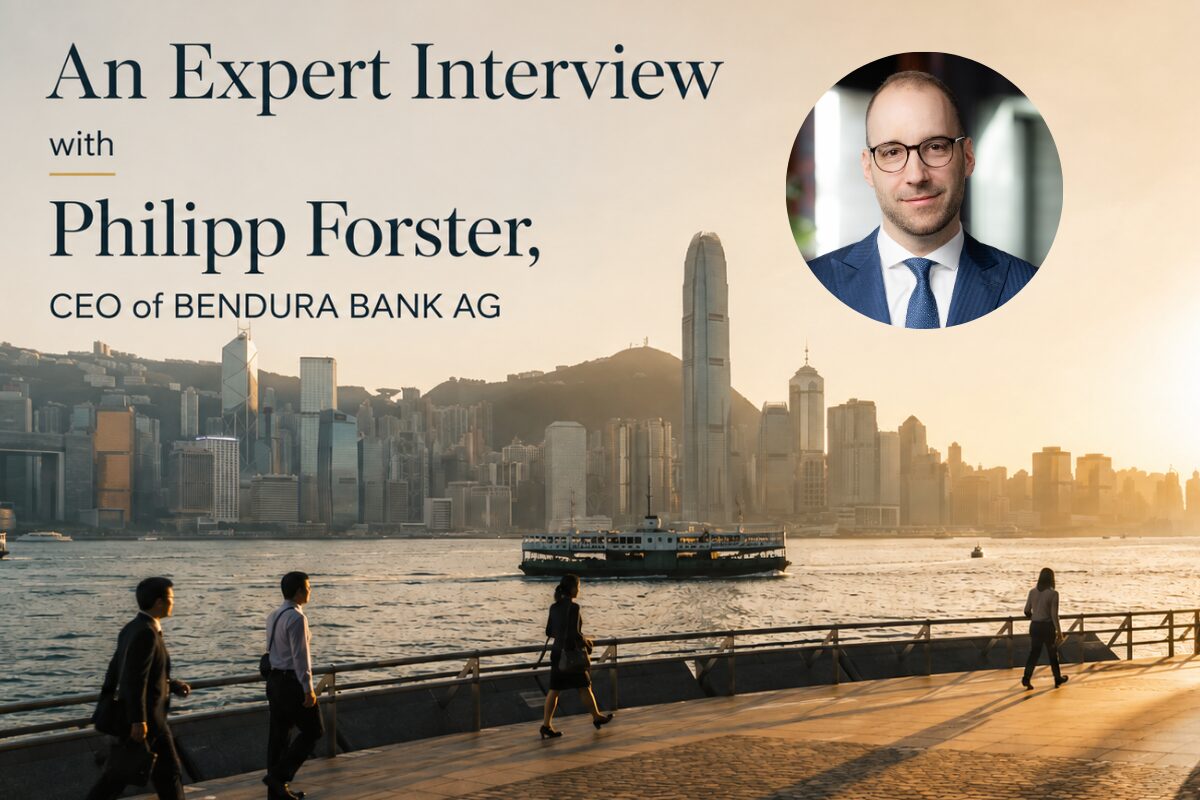
 Philipp Forster, CEO of BENDURA BANK AG, on financial centres between Europe and Asia, the German market, and what a decade of experience in Hong Kong and broader Asia taught him.
From its Liechtenstein headquarters, BENDURA BANK AG has built its model around a discreet banking bridge between Europe and Asia. Its CEO, Philipp Forster, who spent five years building the bank’s presence in Hong Kong before returning to lead it, reflects on the standing of the world’s leading financial centres, the enduring pull of Germany’s entrepreneurial families, and the patience that long-term opportunities in Asia demand.
Hong Kong remains one of the world’s leading financial centres. How do you assess the city’s position in the global economy today?
I have spent many years living and working in Hong Kong, supported by over a decade of experience across Asia, so my perspective is shaped less by headlines and more by first-hand experience. Hong Kong has been tested in recent years – by the pandemic, by geopolitical tension, by sharper competition from Singapore. But its structural foundations remain intact: a common-law system, the free movement of capital, deep and liquid markets, and a concentration of professional talent that is genuinely hard to replicate.
What makes Hong Kong distinctive is its function as an interface, the point where international capital meets the growth of mainland China and the wider region, within a legal framework that Western institutions understand. That role has evolved, but it has not disappeared. For a bank that operates between Europe and Asia, Hong Kong remains an essential reference point, and I expect it to stay one.
Switzerland has long been regarded as one of the world’s leading wealth management centres. How do you assess the Swiss private banking market today, and what are the key drivers of future growth?
Switzerland remains the world’s leading centre for cross-border wealth management, built on decades of stability, expertise, and trust. But the market today is more demanding than it has ever been. Margins are under pressure, regulation is more intensive, and clients are both more sophisticated and more mobile.
I see three main drivers of future growth. First, the generational transfer of wealth, enormous sums are moving to a younger, more international generation with different expectations. Second, the shift of wealth creation toward Asia and other emerging markets, which rewards institutions that can genuinely operate across borders. And third, the combination of technology and personal advice, clients want digital efficiency without losing the human relationship. The centres that grow will be those that adapt to all three, rather than relying on reputation alone.
The private banking sector is highly competitive. Where do you see opportunities for smaller, more specialised institutions to gain market share from larger established banks?
The largest banks are built for scale, and scale has its own logic, standardised processes, longer decision chains, and a tendency to step away from situations that are complex or hard to categorise. That is precisely where specialised institutions can create value.
We do not compete on size or on the breadth of a product shelf. We compete on the ability to handle complexity quickly and personally, a cross-border succession, an entrepreneur with assets in three jurisdictions, a structure that does not fit a standard template. In those situations, proximity to the decision-maker matters more than balance-sheet size: a client can speak to the people who actually decide, and receive an answer in days rather than weeks. For me, growth is not the strategy – it is the result of being relevant where larger institutions are not.
Liechtenstein has developed a strong reputation in international wealth management. What are the biggest advantages of Liechtenstein as a banking location compared with other financial centres?
Liechtenstein’s central advantage is a combination almost no other location offers: full access to the European Economic Area together with close monetary integration with Switzerland and the Swiss franc. A client can operate inside the European framework while benefiting from one of history’s most stable currencies.
Beyond that, there is institutional continuity. The role of the princely family reflects a governance model built around stability and long-term thinking – principles that resonate with entrepreneurial families who think in generations, not quarters. The country has a AAA rating, a mature foundation and trust law, and a regulatory environment that is rigorous but pragmatic. And in a world where visibility can create exposure, the country’s relatively low profile is itself a form of risk management. For our clients, Liechtenstein is not simply a safe location – it is a functional platform for managing complexity.
Germany is Europe’s largest economy, yet many wealthy individuals and entrepreneurs continue to look beyond domestic banks. Why does Germany remain an attractive market for a Liechtenstein private bank?
Germany is the largest economy in Europe, and its real strength lies in the Mittelstand, the family-owned companies that form the backbone of the country. A great deal of private wealth in Germany is entrepreneurial wealth, tied to operating businesses and to the families that built them.
These entrepreneurs are increasingly international. They have suppliers, customers, and often family members across several countries, and their wealth is exposed to more than one jurisdiction and one currency. That is exactly the situation we are built for.
A Liechtenstein bank offers diversification across jurisdictions, access to the Swiss franc, and structuring competence for succession and cross-border holdings, alongside a level of discretion and continuity that complements, rather than replaces, existing domestic banking relationships. Germany stays attractive precisely because the need for genuinely cross-border solutions keeps growing.
What challenges does a Liechtenstein-based institution face when building trust and visibility among German clients?
I will be candid: a discreet Liechtenstein bank does not begin a relationship in Germany with the advantage of name recognition. We are not a household brand, and we do not try to be. That means trust has to be earned in a different way.
In practice, it is earned through three things. First, regulatory credibility, we are a fully regulated bank with EEA access and clear deposit protection, and that foundation matters to clients and their advisors. Second, intermediaries – much of our reach in Germany runs through tax advisors, lawyers, and family offices who know our work and stake their own reputation on a referral. And third, consistency over time. Discretion and visibility are in tension, and we have deliberately chosen discretion. The trade-off is that trust builds more slowly, through results and referrals rather than advertising – but in private banking, that is the more durable foundation.
Liechtenstein is often associated with stability, discretion and long-term thinking. Are these qualities still sufficient in today’s financial world, or do clients expect something more?
They remain necessary – but on their own, they are no longer sufficient, and rightly so. The era in which a bank could rely on discretion alone is over.
Today’s clients expect those qualities as a baseline, and then they expect more on top. They expect speed – answers in days, not weeks. They expect digital access to their assets and their advisors. They expect real competence in structuring wealth across jurisdictions, not just safekeeping it in one. And they expect transparency about costs and about how their money is managed. The values associated with Liechtenstein and Switzerland are still a genuine advantage – but only when they are paired with responsiveness and modern execution. Stability without agility is no longer a complete offer.
BENDURA BANK positions itself as a boutique bank. Why do boutique banks continue to play an important role in an increasingly consolidated financial industry?
Consolidation has real benefits, but it also creates a gap. As institutions grow and merge, processes become more standardised, decision chains get longer, and the individual client risks becoming a segment rather than a person. That gap is where boutique banks belong.
A boutique can do something a large institution structurally finds difficult: treat each client as a specific case, make decisions close to the relationship, and remain willing to engage with complexity rather than route it away. The point is not that boutiques are better at everything – they are not.
It is that in a consolidating industry, there will always be clients whose situations do not fit a standardised model, and who value proximity, speed, and continuity. As long as that is true, boutique banks will continue to matter.
Family-owned businesses form the backbone of the German economy. How have the expectations of entrepreneurial families and business owners changed in recent years?
The most significant change is generational. Wealth is passing to a younger generation that is more international, more digital, and more questioning than the one before it.
This next generation expects transparency as a given – they want to understand exactly how decisions are made and what they cost. They are comfortable with technology and expect to access their affairs digitally. Many of them think about more than financial return; questions of sustainability and impact are part of the conversation in a way they were not a decade ago.
And they look for a partner rather than a product provider, someone who understands the family, the business, and the link between the two. At the same time, succession and governance have moved to the centre of the agenda. Families are planning transitions earlier and more deliberately, and they expect their bank to be a competent counterpart in that process.
Having worked across Liechtenstein, Germany and Hong Kong, what differences do you observe in how entrepreneurs, investors and wealthy families approach wealth management and long-term planning?
Having worked in all three, the differences are real and instructive. In the German-speaking world, entrepreneurs tend to approach wealth with structure and caution. Planning horizons are long, succession is taken seriously, precision in tax and legal matters is expected, and discretion is highly valued. The first conversation is often about protecting what has been built.
In Hong Kong and across Asia, the rhythm is different. Decisions tend to be faster, the orientation is more toward opportunity, and the family is very explicitly the unit of wealth – often spanning several generations and several jurisdictions at once. Trust is established personally and tends to precede any transaction; relationships come before business. What unites entrepreneurs everywhere is that they think in generations, not quarters. But the path to a relationship, and the texture of it, is genuinely different – and you only really learn that by living it.
Hong Kong is often seen as a gateway to Asia. From your perspective, what advantages does the city offer European entrepreneurs and family-owned businesses looking to establish a presence in the region?
For a European entrepreneur or family business, Hong Kong offers something unusual: a familiar legal and commercial environment at the doorstep of the world’s fastest-growing region. It operates under common law, capital moves freely, English is a working language, and the professional infrastructure — legal, accounting, banking – is world-class.
Just as importantly, it is a bridge rather than a destination. From Hong Kong you have proximity to mainland China and access to the wider ASEAN region, within a legal and commercial framework that international businesses know well common law, established arbitration, and professional standards they recognise.
For a European company that wants a regional foothold without immediately taking on the full complexity of operating inside the mainland, Hong Kong is often the most natural place to start. It lets you establish a presence, build relationships, and learn the region from a base that feels manageable.
For companies considering a market entry into Asia, Hong Kong is frequently among the first locations evaluated. What factors should business leaders consider when deciding whether Hong
Kong is the right starting point for their regional expansion strategy?
The honest answer is that it depends on what you are trying to achieve, and leaders should be clear about that before they choose a location. The first question is the target market: are you primarily focused on mainland China, on ASEAN, or on the region as a whole? Hong Kong serves all three well, but the emphasis changes the calculation.
The second is the nature of your business. For finance, trading, holding structures, and regional headquarters, Hong Kong is exceptionally well suited. For manufacturing or large-scale operations, other locations may fit better.
Then come the practical factors – talent availability, cost, substance requirements, and the regulatory and tax treatment relevant to your sector. My advice is not to treat Hong Kong as a default, but to test it against a clear strategic objective. When that objective is regional reach within a familiar, common-law business environment, it is very often the right answer – but the decision should be deliberate, not automatic.
Looking ahead, how do you see the relationship between the financial centres of Switzerland, Liechtenstein, Germany and Hong Kong evolving over the next decade?
I expect these centres to grow more complementary rather than more competitive. Each has a distinct role. Switzerland as the established centre of cross-border wealth, Liechtenstein as a specialised platform combining EEA access with the Swiss franc, Germany as a source of entrepreneurial wealth and demand, and Hong Kong as the interface to Asian growth.
The connecting theme is the rise of internationally mobile clients whose lives and assets no longer sit within a single system. Serving them well requires these centres to work together – through corridors, partnerships, and aligned standards – rather than in isolation. I also expect Asia’s weight in global wealth to keep increasing, which makes the link between European centres and Hong Kong more important, not less. The institutions that thrive will be those that can operate credibly across all of these places at once. That is precisely the space in which we have chosen to position ourselves.
If you could offer one piece of advice to European entrepreneurs and investors seeking long-term opportunities in Asia, what would it be?
Be patient, and be present. The most common mistake I have seen European entrepreneurs make in Asia is to approach it as a transaction – to expect that a good product or a strong balance sheet will open doors quickly. It will not. In Asia, trust comes before business, and trust takes time and genuine presence to build.
My own years in Hong Kong taught me that the relationships that matter are the ones you invest in before you need them. So my advice is to think in generations, not quarters; to find local partners you respect and to listen to them; and to show up consistently, not opportunistically. The opportunities in Asia are real and they are long-term – but they reward those who are willing to earn them patiently.
Thank you to Philipp Forster for sharing his insights and experiences with NeoMarketWays. Our conversation highlighted the importance of trust, long-term thinking and personal relationships in an increasingly interconnected world. From the financial centres of Liechtenstein and Switzerland to the dynamic business environment of Hong Kong, his perspective demonstrates how international success is built not only on expertise and capital, but also on understanding different cultures, markets and ways of doing business.
For further information about BENDURA BANK AG, its international private banking services and its unique position between Europe and Asia, please visit the bank’s official website.
Further Insights on Market Entry
- Inside Colombo Port City: Sri Lanka’s Bet on Becoming South Asia’s Next Financial Hub.
- How Startups Successfully Enter International Markets
- Unlocking Europe. A Practical Guide to Market Entry for OEM Companies.
- European Market Entry: Strategies, Partners and Business Expansion Guide
- Hong Kong and the New Geography of Asian Growth. How European Companies Can Build Their Presence Across Asia