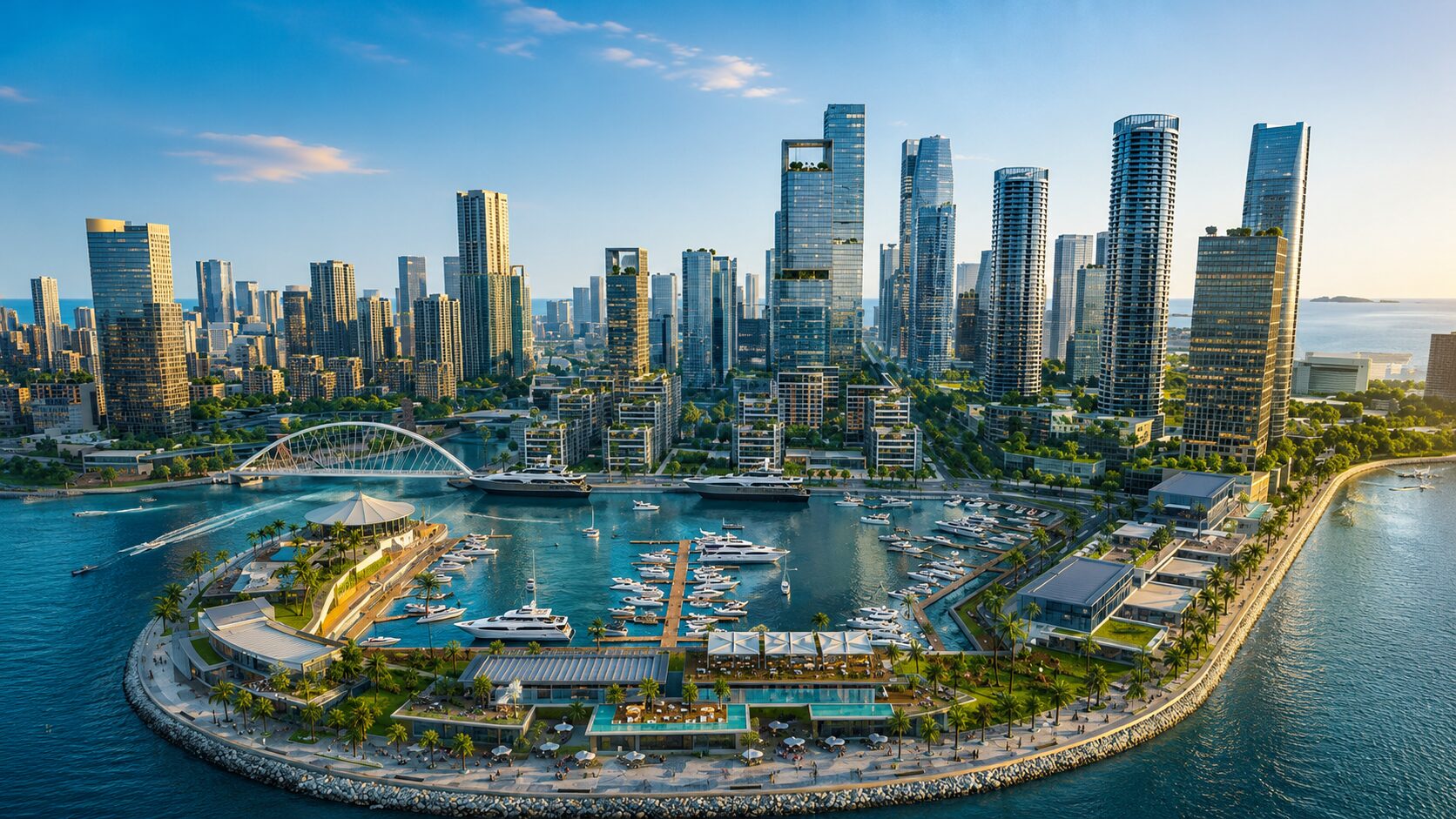
On a reclaimed sandbar off Galle Face Green, where fishermen once cast lines into the Indian Ocean, a different kind of catch is now being pursued. Cranes rise over a 269-hectare peninsula of land dredged from the seabed, and behind the hoardings, the first towers of what Sri Lanka hopes will become South Asia’s answer to Dubai or Singapore are beginning to take shape. This is Colombo Port City and after a decade of false starts, geopolitical entanglement and a national debt crisis, it is finally under construction.
From Reclaimed Land to Investment Destination
The numbers alone suggest momentum. By early 2026, projects worth US$1.2 billion within the Special Economic Zone had received approval and were set to begin construction, with a further US$732 million in applications awaiting sign-off as part of a broader investment pipeline totalling some US$3.9 billion.
In January, construction began on the SEZ’s first residential development, Bay One Residences, a US$112 million waterfront project built by International Construction Consortium. While modest by Gulf megaproject standards, it represents an important milestone. As one executive involved in the project observed, the city is moving “from vision to investable reality”.
A Decade of Delays and Political Uncertainty
It has taken a long time to get here. The project was launched in 2014 by Mahinda Rajapaksa and Xi Jinping, then suspended the following year amid sovereignty concerns and environmental objections before resuming under a revised legal framework.
The Colombo Port City Economic Commission Act of 2021 established a dedicated authority to oversee development and granted the project land under a 99-year lease arrangement. Reclamation works were completed in 2019, while the master plan designed by Skidmore, Owings & Merrill and Grant Associates laid out ambitions for a globally recognizable financial district.
Designing a New City on the Indian Ocean
By the time construction is completed around 2040, Port City Colombo is expected to contain approximately 6.3 million square metres of built space and accommodate more than 273,000 residents. The project includes a financial district, marina, luxury residential developments and the planned International Island district.
The vision is not simply architectural. Sri Lanka is positioning Port City as a strategic location where Western and Asian business hours overlap, offering access to one of South Asia’s most important maritime gateways and creating a platform for regional headquarters, financial services and international trade.
The Fine Print Behind the Skyline
What makes a special economic zone attractive is often less visible than its skyline. In September 2025, Sri Lanka significantly revised its incentive framework as part of broader reforms linked to the International Monetary Fund programme.
Tax holidays were shortened, investment thresholds increased and eligibility requirements tightened. Primary investors can now receive exemptions for up to 15 years rather than the far more generous packages previously offered.
For secondary investors, concessionary corporate tax rates remain available, although for shorter periods than before. The objective is clear: balancing competitiveness with fiscal sustainability.
Governance, Transparency and Investor Confidence
Sri Lankan policymakers argue that the new framework represents a maturation of the project rather than a retreat from international competitiveness.
The revised system introduces technical reviews, mandatory reporting requirements, performance monitoring and periodic assessments of incentive schemes. Tax expenditures are expected to be published, while major exemptions will be reviewed every five years.
For international investors, particularly those familiar with opaque approval processes elsewhere in the region, stronger governance mechanisms may prove as valuable as tax incentives themselves.
Building South Asia’s Next Business Hub
The sectors targeted by Port City Colombo reflect the ambitions of a country seeking to reposition itself within global value chains. Information technology, financial services, logistics, maritime industries, professional services, corporate headquarters functions and tourism all feature prominently in the development strategy.
A recent US$300 million foreign direct investment commitment for the second phase of infrastructure development demonstrates continued confidence in the project’s long-term direction.
Property First, Finance Later?
The earliest wave of private investment has focused largely on real estate. Home Lands has announced plans for a US$300 million twin-tower residential development in the Central Park district, while the city’s duty-free retail complex has already opened its doors.
This pattern mirrors the development path of many emerging financial centres, where residential and commercial property often arrive before the financial institutions they are intended to attract.
The central question remains whether international banks, asset managers and multinational corporations will eventually establish significant operations within the zone, or whether Port City evolves into a high-end waterfront extension of Colombo itself.
A Test Case for Sri Lanka’s Economic Future
Ultimately, Port City Colombo has become more than an urban development project. It serves as a highly visible indicator of investor confidence in Sri Lanka’s broader economic recovery following the country’s 2022 sovereign default.
The pace of capital inflows, construction activity and business formation within the zone is increasingly viewed as a barometer of how international investors assess Sri Lanka’s prospects.
If Port City succeeds, it will not be because of tax incentives alone. Its success will depend on whether Sri Lanka can offer something more valuable: a stable, transparent and globally connected environment that convinces international businesses to look beyond recent crises and commit to the country’s long-term future.
Looking Beyond the Skyline
For now, cranes and construction sites dominate the horizon. Yet the true measure of Colombo Port City’s success will not be the height of its towers, but the quality of the institutions, businesses and international networks that emerge around them. Building a skyline is relatively straightforward. Building lasting investor confidence is considerably harder—and ultimately far more important.

Further Insights on Market Entry
- Beyond the Crisis: Why Sri Lanka Deserves a Fresh Look from European Business
- How Startups Successfully Enter International Markets
- Unlocking Europe. A Practical Guide to Market Entry for OEM Companies.
- European Market Entry: Strategies, Partners and Business Expansion Guide
- Hong Kong and the New Geography of Asian Growth. How European Companies Can Build Their Presence Across Asia