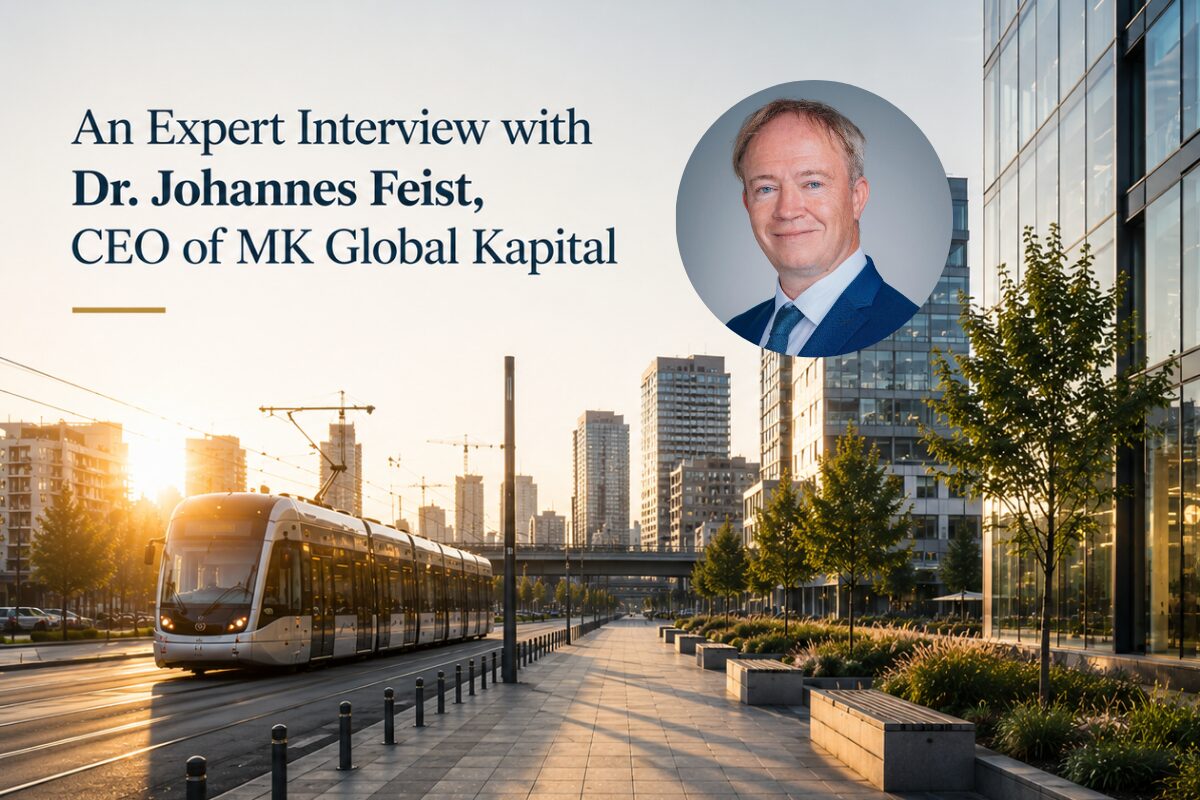
In a world where venture capital, private equity and public markets often dominate investment discussions, another segment of finance continues to grow quietly in the background. Across Central and Eastern Europe, specialised financing models are helping small businesses gain access to vehicles, equipment and productive assets that traditional banks do not always provide. At the same time, new mobility concepts, including car-sharing and operating leasing, are creating investment opportunities closely linked to the real economy.
 In this interview, Dr. Johannes Feist, CEO of MK Global Kapital, explains how microfinance has evolved into a professional asset class, why asset-based financing is gaining relevance across emerging European markets and how mobility platforms such as car-sharing are reshaping the relationship between capital, ownership and economic growth. The conversation also explores investment opportunities in Czechia, the role of leasing in scaling businesses and the broader shift from ownership towards access in modern economies.
Can you give examples of projects or companies that you finance?
One example that is particularly relevant for NeoMarketWays is the car-sharing business in Czechia. Through the group’s exposure to D-Mobility / Anytime Czechia, Prague can be seen as a practical case in which financing, local execution and urban mobility come together.
This is not an isolated add-on to our work. Shared mobility is part of the broader access theme: people and businesses do not always need ownership; they need reliable access to mobility.
What role does due diligence play in operating leasing?
It is central. In operating leasing, the quality of the asset is just as important as the quality of the borrower. You need to understand who uses the asset, how it generates revenue, how it is maintained, what residual value it may have and what happens if the business plan develops differently than expected.
That is precisely why local presence matters. Due diligence is not merely a review of documents from a distance. It requires people who understand the market, the customer, the asset and the practical conditions on the ground. In a mobility model, this becomes especially concrete: fleet utilisation, maintenance, insurance, location data and user behaviour all play a role. The question is not only whether a company can pay today. What also matters is whether the financed asset remains economically useful and controllable over time.
What is the repayment rate of the loans granted, and how do you protect against non-performing loans?
I would not reduce this to a general repayment rate without specifying the portfolio, period and asset type. That would not be precise enough. In practice, we look at several indicators: repayment behaviour, portfolio-at-risk metrics, collateralisation, recovery proceeds, currency risks and liquidity management.
The important point is that risk management starts before disbursement. We assess the borrower, the asset, the cash flow and the legal enforceability of the structure. After disbursement, ongoing monitoring remains decisive.
In leasing, the financed asset itself is part of the risk framework. Current repayment or NPL figures at portfolio level should be confirmed by MK Global Kapital before publication.
Why is Czechia, and Prague in particular, an interesting market for car-sharing? In which cities are you already supporting projects, and where do you see further potential?
Prague has several characteristics that make car-sharing relevant: dense urban areas, strong public transport, limited parking space, high app usage and users who do not need their own car every day. Car-sharing works particularly well where people can combine different forms of mobility. In that sense, Prague is a good example of a more flexible urban model.
The Czech market has also grown significantly. The Czech Carsharing Association reports a total of 2,149 shared vehicles in 2026, three active providers and twelve cities. In 2014 there were only 30 shared vehicles. Anytime is one of the active providers. The current Anytime website lists Prague, Plzen and Kladno as cities and refers to 640 shared vehicles in one app.
What is particularly interesting is that car-sharing is not just an occasional convenience product. Sixty percent of users in Czechia do not own a car, and 40 percent use car-sharing as their primary means of transport. This points to a real shift from ownership to access.
What role does your service play for and within the Czech startup culture?
I would not describe us as a startup incubator. Our role is more specific. We can support asset-intensive business models that need financing in order to scale. This is particularly important in mobility, because growth often requires a fleet, technology, maintenance processes and local operating structures.
Many startups can develop software quickly. Scaling physical infrastructure is different. It requires capital discipline, asset management and operational control. This is where financing partners with sector expertise can add value: not by replacing entrepreneurs, but by helping real-economy models move from the idea stage to operational scale.
What cross-border activities are there?
Feist: MK Global Kapital is internationally positioned. Capital is structured in Luxembourg and deployed through portfolio companies in local markets. The value of this model lies in the fact that experience can be used across borders, while implementation remains local.
In Czechia, cross-border mobility is already part of the user offering. Anytime offers selected international trips, including a “Weekend in Vienna – 48 hrs + 700 km” tariff; in addition, 26 percent of trips in Czechia are used for travel. The broader point is that shared mobility can cover not only urban routes, but also regional and cross-border mobility when users want to remain flexible without owning a car.
What measures have you taken to intensify market penetration?
In car-sharing, market penetration is rarely driven by a single measure. Vehicle availability, ease of use, transparent pricing, parking options and trust in the service are decisive. Digital access is important, but it is not enough on its own. Users need to feel that a vehicle is available when and where they need it.
From a financing perspective, the most important contribution is to make fleet growth and fleet renewal possible. A car-sharing service cannot scale without vehicles. Leasing helps translate market demand into operational capacity. There is also a business-use aspect: Anytime is aimed not only at private users, but also at entrepreneurs and small businesses that use vehicles for meetings, deliveries, site visits or daily operations.
Who are the typical car-sharing users in Czechia, and what types of vehicles do you operate?
Typical users are people who do not need their own car every day, but want flexible access to a vehicle on certain occasions: for shopping, family trips, business appointments, trips to the airport or journeys that are less convenient by public transport. In Prague, this may include younger urban users, professionals, families or occasional visitors.
For example, 54 percent of drivers are under 30, 15 percent are women, 60 percent of users in Czechia do not own a car and 40 percent use car-sharing as their primary means of transport. The car-sharing service has 44,775 monthly active users and recorded 749,000 trips in 2025.
What distinguishes car-sharing in Czechia from the common understanding of car-sharing in Germany?
The German market is larger and more mature, with a longer tradition of station-based and free-floating models. Czechia is smaller, but it is developing dynamically and is more concentrated around a few providers and central cities.
In Prague, the free-floating, app-based model is particularly relevant because it fits the way people move through the city. Users think less in terms of ownership and more in terms of access. That is the key point: car-sharing becomes part of a broader mobility mix and does not replace every other form of transport. From a market-entry perspective, this is interesting because it shows how local habits, parking policy, public transport and digital use shape a business model.
What role does the expansion of charging infrastructure play in Czechia?
It is decisive for the next stage of e-mobility. A fleet model can only deploy more electric vehicles if charging is reliable, accessible and economically practical. Otherwise, vehicle availability suffers.
The Czech charging network is growing, although public datasets can differ depending on scope and methodology. For a car-sharing and leasing model, therefore, one single number is not decisive; the direction of travel is. Charging availability is improving and remains a critical condition for scaling electric fleets. That is why infrastructure, vehicles and financing have to be considered together.
How large is the e-mobility market in Czechia, and what are the growth prospects?
The Czech e-mobility market is growing, but compared with some Western European markets it is still at an earlier stage. This combination is interesting: there is visible momentum, but also significant room for further development.
The latest public market data continue to show rising registrations of battery-electric vehicles and an expansion of charging infrastructure. For investors, this means that e-mobility is not only a consumer topic. It is also an infrastructure and financing topic. Vehicles, charging infrastructure, fleet renewal and digital mobility services require capital. This is exactly where leasing and structured financing can play a role.
Our thanks go to Dr. Johannes Feist for sharing his insights and perspectives with NeoMarketWays. As the discussion demonstrates, the future of economic development in Eastern Europe is shaped not only by the availability of capital, but by the ability to deploy it effectively in support of entrepreneurship, mobility and productive economic activity. From microfinance and leasing to shared mobility and emerging investment opportunities, the region continues to offer valuable lessons on how finance can contribute to sustainable growth in the real economy.
- To learn more about MK Global Kapital’s approach to asset-based finance, mobility and emerging market investments, explore the company’s activities and portfolio in greater detail.
Further Insights
- Beyond the Recovery: Why Sri Lanka’s Consumer Market Deserves a Closer Look
- How to Find Distributors in Europe: A Market Entry Guide for Consumer Brands
- 7 High-Growth Industries in Czechia, Slovakia and Hungary to Watch Through 2030
- Manufacturing Expansion in Europe. Key Markets, Cost Structures and Location Strategies.
- Unlocking Europe. A Practical Guide to Market Entry for OEM Companies.
- European Market Entry: Strategies, Partners and Business Expansion Guide