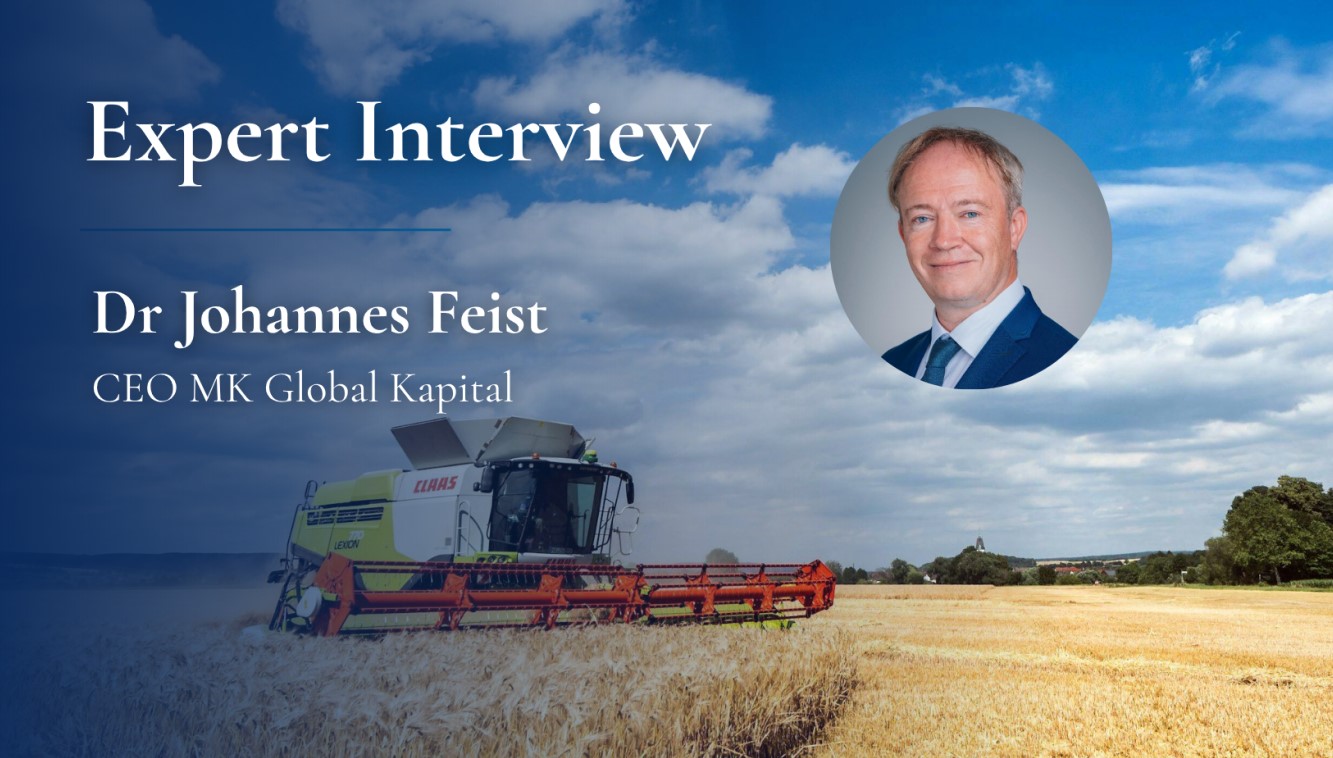
Germany’s smaller cereal harvest in 2026 has brought a familiar challenge back into focus: how can agricultural businesses manage immediate financial pressures while continuing to invest in their future? With additional liquidity support on the horizon, the question is no longer simply how much funding is available, but whether the financing fits the needs of individual farms.
 In this expert Q&A, Dr Johannes Feist, CEO of MK Global Kapital, examines the financial challenges facing German agriculture, the distinction between short-term liquidity and long-term investment, and why well-structured financing matters for building a more resilient agricultural sector. What matters is not simply how much capital is available, but whether the financing matches the farm’s needs.
A smaller harvest and growing financial pressure
NeoMarketWays: Germany’s 2026 cereal harvest has fallen considerably compared with last year. How significant is this development for agricultural businesses?
Preliminary official figures put Germany’s cereal harvest, excluding grain maize, at around 37.4 million tonnes. That represents a decline of 7.3 per cent compared with 2025 and a reduction of 2.1 per cent against the average for 2020 to 2025.
However, the national figures tell only part of the story. The differences between crops and regions are considerable. Drought and heat have affected agricultural production to varying degrees, with particularly pronounced cereal harvest losses in southern Germany. Maize and forage production have also been affected in the south and south-west.
For individual farms, the financial consequences therefore depend heavily on their location, production structure and exposure to weather-related risks.
NeoMarketWays: Germany’s Landwirtschaftliche Rentenbank is planning to expand its liquidity support programme from €200 million to €500 million. Is this the right response?
Expanding liquidity support can help agricultural businesses manage immediate financial pressures. When farms face short-term cash-flow difficulties, access to appropriate financing can be important.
However, not every financing requirement can sensibly be addressed through additional borrowing. We need to distinguish between temporary liquidity shortages and longer-term investment needs.
A farm that needs to cover payments for seed, diesel, fertiliser or feed faces a different financial challenge from a business planning to invest in irrigation systems or more efficient machinery. Both require capital, but they do not necessarily require the same financing instruments.
Why the purpose of financing matters
NeoMarketWays: What is the most important distinction between financing day-to-day operations and financing agricultural investment?
A temporary cash-flow shortfall can often be addressed through short-term financing. The objective is to bridge the period between expenditure and incoming revenue.
Long-term investments require a different assessment. When a farm purchases machinery, installs irrigation equipment or undertakes other substantial improvements, the key questions are whether the investment makes economic sense and whether the associated financial commitments can be managed over several years.
The repayment structure should reflect the period over which an investment generates returns or cost savings. This is particularly important in agriculture, where income is often seasonal.
“A cash-flow shortfall is not the same as an investment. Both require capital, but not necessarily the same form of finance.”
NeoMarketWays: Agricultural businesses also need to adapt to changing weather conditions. How should these investments be financed?
Investments in irrigation, more efficient equipment and other adaptation measures can help farms reduce costs, use resources more efficiently and become less vulnerable to weather and price fluctuations.
However, the appropriate financing model depends on the economic characteristics of the investment.
Some projects generate sufficient long-term benefits for the farm itself. Others create wider public benefits while delivering only limited or delayed financial returns to the individual business. In such cases, public co-financing may be appropriate.
Where an investment is economically viable but cannot proceed because of high initial costs or risks during the transition period, guarantees or more favourable financing conditions may help. The important point is that financing instruments should reflect the specific economic circumstances of the investment.
Investment remains essential despite uncertainty
NeoMarketWays: Recent surveys suggest that farmers are becoming more concerned about liquidity, yet many continue to invest. How do you interpret this?
The proportion of farms assessing their liquidity position as good or very good has fallen from 42 to 31 per cent since the spring.
At the same time, investment activity continues. According to the survey figures, 74 per cent of respondents have invested during the previous twelve months, while 57 per cent intend to invest over the coming twelve months. However, these figures do not tell us how large those investments are.
Rentenbank’s findings at the beginning of the year indicated that average investment volumes had declined. Farms were increasingly concentrating on replacement investments and smaller measures, while larger projects were often postponed or did not proceed.
That distinction is important when assessing the longer-term development of the sector.
NeoMarketWays: Could postponing larger investments create additional risks for agricultural businesses?
It can, particularly when economically worthwhile projects are delayed for extended periods.
Investments in irrigation systems or more efficient machinery, for example, may help agricultural businesses reduce operating costs, improve water efficiency or become less exposed to weather-related disruption. When such investments are repeatedly postponed, farms may lose opportunities to strengthen their resilience.
At the same time, investment decisions must remain economically sound. The objective should not be to encourage borrowing for its own sake, but to ensure that viable projects can proceed with appropriate financing.
Planning liquidity and investment together
NeoMarketWays: What should agricultural businesses consider when developing their financing strategies?
Short-term liquidity requirements, existing payment obligations and planned investments should be considered together rather than in isolation.
This provides a clearer picture of which projects are economically viable, what level of financial commitments a business can sustain and which financing instruments are appropriate. The maturity and repayment profile of financing should also reflect the expected returns or cost savings from an investment.
For businesses with seasonal income patterns, repayment schedules need to take account of when revenue actually arrives. Otherwise, even an economically sensible investment can create unnecessary financial pressure.
NeoMarketWays: Looking beyond the immediate consequences of the 2026 harvest, what should policymakers and financial institutions focus on?
The debate should not be limited to the amount of short-term liquidity support available.
It is equally important to consider which investments will make economic sense for agricultural businesses over the coming years and how those investments can be financed appropriately. Different financial needs require different solutions. Temporary liquidity shortages, commercially viable long-term investments and projects delivering wider public benefits should not automatically be treated in the same way.
Financing that does not match the underlying need can lead to unnecessary debt or prevent worthwhile investments from going ahead.
Ultimately, the objective should be to make capital available in a form that supports both the financial stability and the long-term resilience of agricultural businesses.
“The question is not simply how much financing agriculture needs, but which form of financing allows worthwhile investments to move forward.”
Looking ahead
Germany’s 2026 harvest figures highlight the financial pressures that agricultural businesses can face when production conditions deteriorate. While expanded liquidity programmes may help address immediate difficulties, longer-term resilience depends on investment decisions and financing structures that reflect the realities of agricultural production.
The distinction between short-term support and investment capital is therefore central to the debate about the future of agricultural finance.
About the Expert
Dr Johannes Feist is CEO of MK Global Kapital. He has nearly 30 years of experience in development finance, SME finance and the financing of rural businesses. Previously, he spent 20 years in various senior positions at KfW.
- To learn more about MK Global Kapital’s approach to asset-based finance, mobility and emerging market investments, explore the company’s activities and portfolio in greater detail.
Further Insights
- Beyond the Recovery: Why Sri Lanka’s Consumer Market Deserves a Closer Look
- How to Find Distributors in Europe: A Market Entry Guide for Consumer Brands
- 7 High-Growth Industries in Czechia, Slovakia and Hungary to Watch Through 2030
- Manufacturing Expansion in Europe. Key Markets, Cost Structures and Location Strategies.
- Unlocking Europe. A Practical Guide to Market Entry for OEM Companies.
- European Market Entry: Strategies, Partners and Business Expansion Guide